"I wake up with a tired jaw, and when I eat there's a click just in front of my ear." Quite a few patients who say this to us actually booked an appointment for neck pain or headaches; the jaw comes up almost in passing, halfway through the examination. Yet that morning tiredness and that click tell us a lot: how the night went, how often the teeth are clenched during the day, and how the neck is being carried.
In this article we look at jaw joint pain (temporomandibular disorders, often shortened to TMD or simply "TMJ problems") the way we explain it in the treatment room: why the joint clicks, when it matters and when it doesn't, where clenching and stress come in, what we do in physiotherapy, and at what point you should see a dentist or doctor instead.
What is the temporomandibular joint, and why does it click?
Put a fingertip just in front of your ear and open and close your mouth. The part moving under your finger is the temporomandibular joint, where the lower jaw meets the skull. It is not a simple hinge: as the mouth opens, the jaw first rotates and then glides forward. Between the two bony surfaces sits a small cartilage disc that cushions the movement and slides back and forth with the bone.
The power comes from the chewing muscles in the temples and cheeks, some of the strongest muscles in the body. Clench your teeth and you can feel the muscle harden under your hand on the side of your face. Most jaw pain starts in these muscles rather than in the joint itself.
A click usually means the timing between disc and bone is slightly off: the disc has shifted a little forward, and as the mouth opens the bone "jumps" over it. It can sound alarming, but on its own a click is not a sign of damage.
Four common pictures of jaw pain
In the clinic we roughly sort jaw complaints into four groups. One person can have more than one at the same time.
- Muscle-related pain: the most common picture we see. Overworked chewing muscles cause a dull ache in the temple, cheek or in front of the ear, and a tired feeling in the morning. Long conversations or tough food make it worse.
- Clicking from disc displacement: a click when opening or closing, with or without pain.
- Locking: the disc blocks the movement and the mouth won't open fully; patients say "I can't fit two fingers in". Sometimes the jaw catches on the way closed instead.
- Joint-related pain: inflammatory or wear-related changes inside the joint itself, felt as a pinpoint ache in front of the ear that clearly increases with chewing.
We want to be honest about one thing: a painless click usually doesn't need treatment on its own. Plenty of people have a jaw that clicks and live with it perfectly well. If there is no pain, no restriction in opening and no catching, we don't recommend an intensive treatment programme just to silence the sound. Keeping an eye on it and adjusting a few habits is usually enough.

What overloads the jaw? Clenching, stress and everyday habits
During the day the jaw muscles should do surprisingly little work. They switch on for talking and eating, and the rest of the time the teeth shouldn't touch. Trouble begins when the muscles lose that rest time.
The most common trigger is bruxism: grinding the teeth at night or clenching them during the day without noticing. Most night grinders don't know they do it; a partner hears the noise, or a dentist points out the wear on the teeth. Daytime clenching is sneakier because it makes no sound. At the computer, in traffic, during a difficult phone call or in any task that needs intense focus, the jaw locks itself shut, and people only notice when someone asks.
Stress is the fuel. Under pressure both night grinding and daytime clenching increase, and our patients often describe flare-ups during exams, a job change or a family crisis. Small but constant habits add to the load: chewing gum all day, biting nails, chewing a pen or the arm of your glasses, wedging the phone between shoulder and ear.
A forward head posture also tires the jaw. As the head drifts forward, the jaw and neck muscles work under a different load and the teeth tend to drift together. Finally, long dental sessions: keeping the mouth wide open for a long time strains the muscles and the joint, and pain or difficulty opening can start in the days that follow.
Antalya gives this picture a local face. Hotel and restaurant staff working back-to-back long shifts in the season, call-centre agents on a headset all day, construction and greenhouse workers who clench their teeth while lifting heavy loads all come in with tired jaws. Then there are visitors who travel to Antalya for dental treatment: after long implant sessions squeezed into a few days, we regularly see people whose jaw is exhausted and won't open fully. In most of them the joint itself is fine; the muscles are overloaded and need rest and the right guidance.
The jaw, the neck and headaches: links in the same chain
Jaw pain rarely comes alone. Tension in the chewing muscles spreads to the temples and is felt as a headache. The neck muscles work together with the jaw, so extra tension in one affects the other. That is why we always check the jaw in patients with a tight, band-like ache in the temples and the back of the head. We explain this link in more detail in our article on tension headaches and the neck muscles.
Posture is part of the same chain. A head bent towards a phone or screen pulls the lower jaw back and down, and the jaw muscles work extra all day just to keep balance. If you have read our piece on tech neck and posture, you will recognise the same mechanism reaching up to the jaw.
Looking only at the jaw in jaw pain means seeing half the picture. The neck, posture and daytime clenching are all parts of the same story.
What we look at during the examination
We start by listening: when the pain began, whether it is worse in the morning or the evening, whether you know you clench or grind, whether you've had long dental work recently, and how stress and sleep have been. Then we examine.
First comes mouth opening and deviation. We measure how wide the mouth opens and watch whether the jaw travels in a straight line or swings to one side and then corrects itself. The direction and timing of that swing give us a clue whether the problem is mainly muscular or related to the disc. Then we listen to the joint: is it a click or a grating sound, and does it happen on opening, on closing or both?
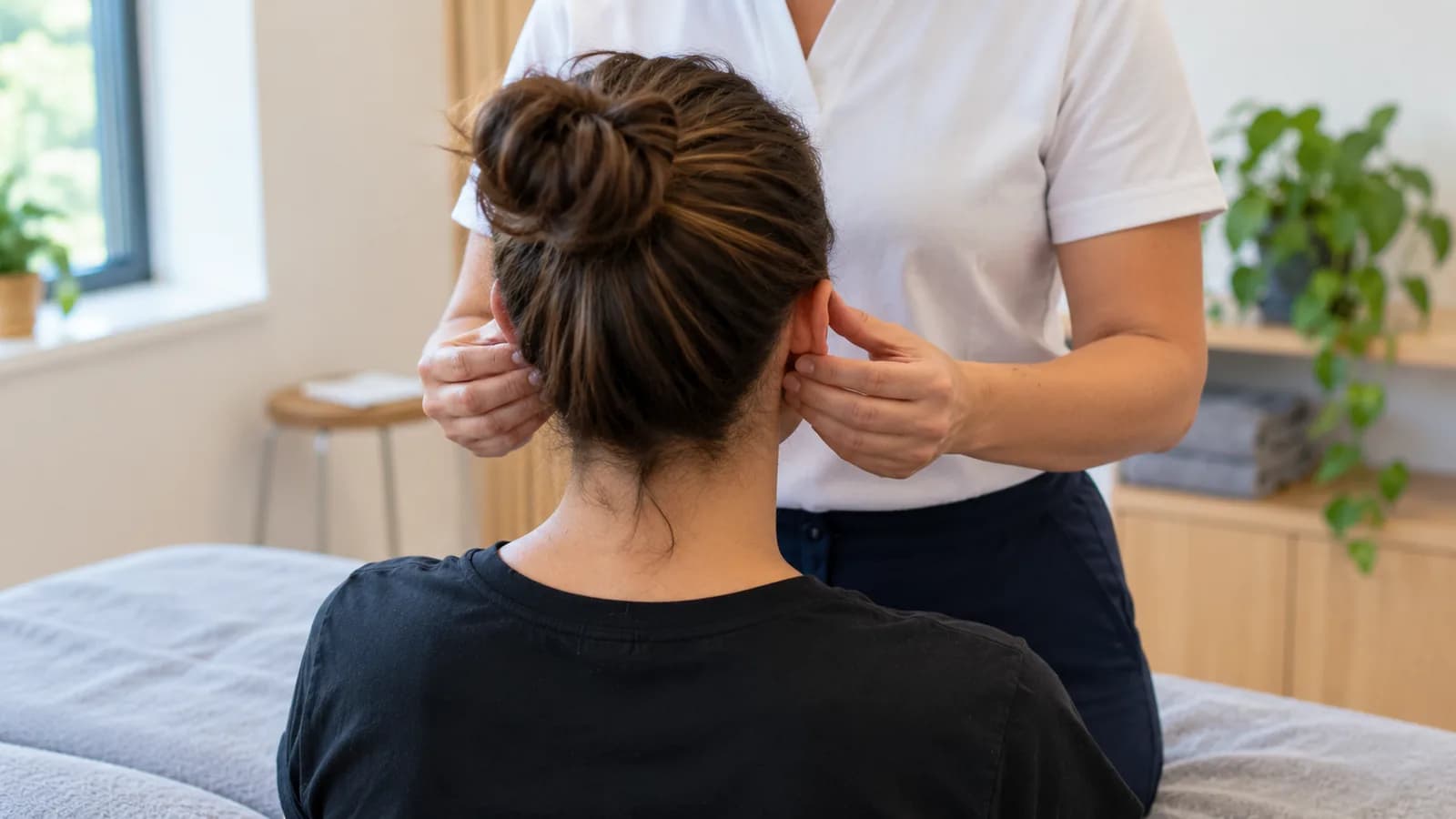
We assess muscle tenderness by hand, from outside the mouth and, where needed, from inside with a gloved finger, and together with the patient we find the points that reproduce the familiar pain. Finally we screen the neck: movement, the muscles at the back of the neck, and the position of the head and shoulders. Many people who come in with jaw pain also have a stiff neck, and we treat the two together.
If anything during the examination means you should see a dentist, an ENT specialist or another doctor, we tell you plainly. Not everyone needs imaging such as X-rays or MRI; that decision belongs to the relevant doctor.
Treatment: what we do, and what the dentist does
A large part of treating jaw pain happens outside the clinic, in everyday life, so the first sessions focus on teaching you what to do.
The foundation is the resting position of the jaw: lips closed, teeth apart, tongue resting on the roof of the mouth. In this position the jaw muscles can relax. We ask you to check yourself several times a day; a small sticker on the screen or a phone reminder works well. Most people are surprised in the first week by how often they catch themselves clenching, and that awareness is already part of the treatment.
During a painful phase we suggest a few days of soft food: a break from hard, chewy food and big bites, and no chewing gum. It isn't a diet, just a breather for tired muscles, and you return to normal eating gradually as the pain settles.
In the clinic we use manual therapy for the jaw muscles and the neck: soft tissue techniques for the chewing muscles, gentle mobilisations to ease the joint, and work on the neck and upper back muscles. We combine this with controlled opening and closing exercises; in front of a mirror you learn to open and close without deviation within a pain-free range, and repeat it at home a few times a day. Gentle warmth on the muscles helps many people. Breathing and relaxation work is part of the programme too, because the jaw rarely lets go while stress stays high.
For people with marked night grinding, a night guard (splint) may be considered. Whether you need a splint is the dentist's decision, not the physiotherapist's; the dentist takes the impression, adjusts it and follows up. We work alongside the dentist in these cases: the splint protects the teeth at night, while we deal with daytime habits, the muscles and the neck.
An honest limit: most people with jaw joint problems improve with this kind of conservative care, but the course varies from person to person. Some feel better within a few weeks; others learn to manage symptoms that come back in stressful periods. Surgery is rarely considered, and that is a decision for a maxillofacial surgeon.

When not to wait
In the following situations please see a doctor or dentist first rather than starting with physiotherapy:
- Your mouth has suddenly locked completely and won't open or close.
- There is swelling, redness and fever over the jaw joint.
- After a blow or fall, your bite has changed and the teeth no longer meet as before.
- There is discharge from the ear or hearing loss.
- You have unexplained numbness in the face.
- Jaw pain comes on with exertion together with chest pain. This can be heart-related pain; go to an emergency department without delay.
For independent, detailed information on jaw joint problems, the NHS page on temporomandibular disorder is a good place to read further.
If your jaw feels tired in the mornings, the clicking comes with pain or restricted opening, and these symptoms have lasted more than two weeks, you are welcome to come to our clinic for an assessment. We look at the jaw, the neck and your daily habits together and, where needed, work on the same plan as your dentist.