"By the evening my legs feel like lead, and my socks leave a deep mark around the ankle." We hear this sentence most often in summer, from patients who spend the whole day on their feet. The legs feel light in the morning, grow heavy in the afternoon and the ankles are puffy by evening; after a night lying flat, most of the swelling has gone again. Behind this daily cycle there is usually a strain on the veins, the vessels that carry blood back to the heart.
In this article we look at the venous side of evening heaviness and swelling in the legs: how blood returns from the legs, what the calf muscle has to do with it, what happens when the valves inside the veins weaken, and where movement fits in. Lymphedema and lipedema are separate conditions; we will only outline the differences and point you to our articles on them. One thing first: some kinds of leg swelling should never be watched and waited on. We have gathered them in a separate section at the end.
How does blood get back up from the legs? The calf muscle pump
Arteries carry blood downwards with the force of the heart. The return trip is uphill, against gravity, and much harder work. Inside the veins sit small one-way valves: as blood moves upwards, they close behind it and stop it from sliding back.
The main force pushing that blood upwards is the calf muscle. With every step the calf contracts, squeezes the deep veins running through it and drives blood towards the heart; as the muscle relaxes, the valves close and the vein refills from below. That is why the calf is often called the "second heart". The network of veins in the sole of the foot also helps, as it is compressed each time you put weight on it.
The pump only works when you move. If you stand still for hours, or sit with your legs crossed, the calf barely contracts. Blood pools in the lower leg, pressure inside the veins rises and some fluid seeps into the surrounding tissue. The heaviness, the aching and the sock marks you notice in the evening are largely the result.
Valve failure: from spider veins to varicose veins
Over time the valves can weaken or stop closing properly. This is called chronic venous insufficiency. With every step a little blood slips backwards, the lower segments of the vein are overloaded and gradually widen.
It often starts subtly, with spider veins: fine red or purple threads spreading like a net under the skin. These are mostly a cosmetic matter. In some people, twisted, bulging, bluish veins become visible over the years; these are varicose veins. They can come with evening heaviness, aching, itching and night cramps in the calf. When advanced insufficiency is left alone for a long time, the skin around the ankle may turn brownish, harden and even break down into an ulcer.
Not every heavy leg means varicose veins, and venous insufficiency can exist without visible veins. We make this distinction during the examination and, where needed, refer patients to a doctor for a Doppler ultrasound, which shows how blood flows in the veins. For a clear, independent overview, the NHS page on varicose veins is a good place to start.
Venous swelling, lymphedema or lipedema?
Some patients who come to us saying "my leg is swelling" have a vein problem, some have a lymphatic problem, and in others the issue lies in the fatty tissue itself. These are the first clues we look for:
- How it changes during the day: venous swelling is mild in the morning, builds up towards evening and largely settles overnight. Lymphedema tends to become persistent and is still there in the morning.
- Response to elevation: swelling from the veins eases noticeably when the leg is raised. In established lymphedema, elevation alone is not enough.
- One side or both: venous insufficiency can affect both legs, though one is usually worse. Lymphedema often starts on one side; lipedema is almost always symmetrical.
- The foot: in lipedema the fat stops at the ankle and the top of the foot stays slim. In lymphedema the top of the foot and the toes can swell too.
- Tenderness: in lipedema the tissue is painful to touch and bruises easily. Venous problems feel more like heaviness and a dull ache.
You can make a simple observation at home, too. For a few days, check your ankles morning and evening, press your thumb into the swollen area for a few seconds to see whether it leaves a dent, and notice how long the swelling takes to go down when you put your feet up. Bringing these notes to the appointment makes the picture much clearer.
Our article on lymphedema symptoms and manual lymphatic drainage covers swelling of lymphatic origin, and our piece on how lipedema differs from lymphedema explains the symmetrical, tender fullness of the legs typical of lipedema. Keep in mind that these conditions can overlap: long-standing venous insufficiency can also overload the lymphatic system.
Who is at risk? Familiar examples from Antalya
Family history is one of the strongest factors; if a parent had varicose veins, your chances are higher. With age, vein walls and valves become less resilient. In pregnancy, hormones relax the vein walls and the growing womb presses on the large veins in the abdomen, which is why many women notice their first varicose veins while pregnant. Extra body weight also adds to the load on the leg veins.
Work is perhaps the most overlooked factor. In Antalya we see it every day: hotel receptionists standing in the same spot for eight to ten hours, cooks who barely leave the counter in a hot kitchen for a whole shift, housekeeping staff bending and straightening through room after room, and cashiers or office workers sitting for hours. Standing still for long periods and sitting for long periods both silence the calf pump.
Then there is the heat. Warmth widens the veins, and in Antalya's July and August evening swelling clearly gets worse. Lying for hours on hot beach sand, long hot showers and saunas have the same effect. Visitors arriving on long flights are a group of their own: four or five hours in a narrow seat without moving is enough to make the ankles swell. On the plane, circling and flexing your ankles every half hour, taking a few steps down the aisle when you can and drinking enough water are simple measures that genuinely help.
Physiotherapy and self-care: getting the calf pump working
In venous insufficiency, the physiotherapist's main job is to get the calf pump working again and to teach you how to spread that work throughout the day. During the assessment we do not only look at the swelling; we also check calf strength, ankle mobility and the way you walk. An ankle that has stiffened after an old sprain or from arthritis cannot drive the calf pump fully, so freeing up that joint becomes part of the programme.
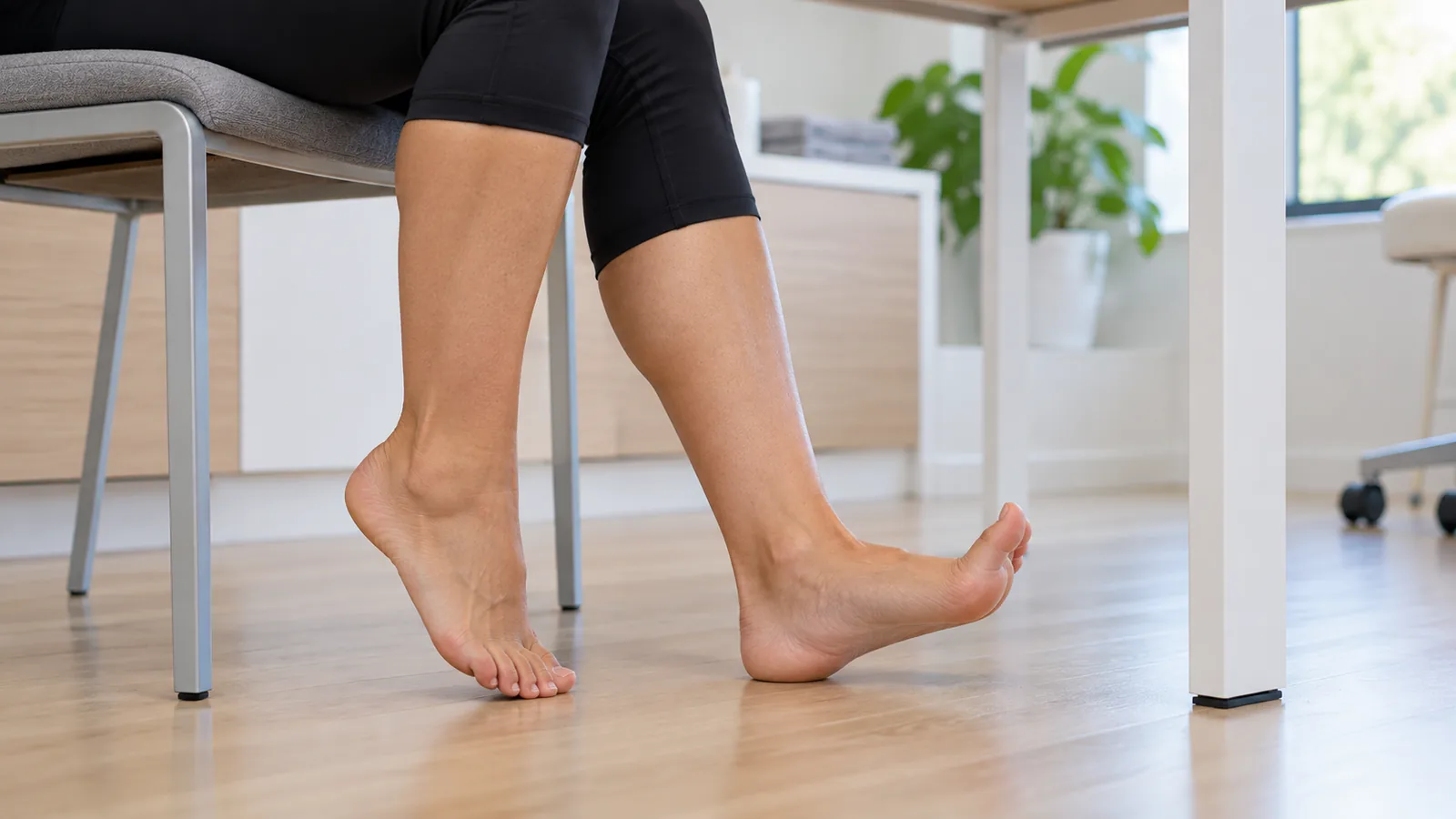
Ankle pumps: sitting or lying on your back, pull your toes towards you, then point them away. Repeat 20 to 30 times in a steady rhythm; this works at a desk and on a plane as well.
Heel raises: holding on to a table or counter, rise onto your toes, hold for two seconds and lower slowly. A few sets of 10 to 15 work the calf directly.
Walking: the most natural calf exercise there is. In summer, walk at your own pace early in the morning or in the cooler evening rather than in the midday heat.
Raising your legs slightly above heart level during the day, even for 15 to 20 minutes, helps pooled fluid drain back. For people who sit or stand for long periods we suggest a short break every hour: rising onto your toes behind the reception desk or shifting your weight from foot to foot in the kitchen already gives the pump some work.
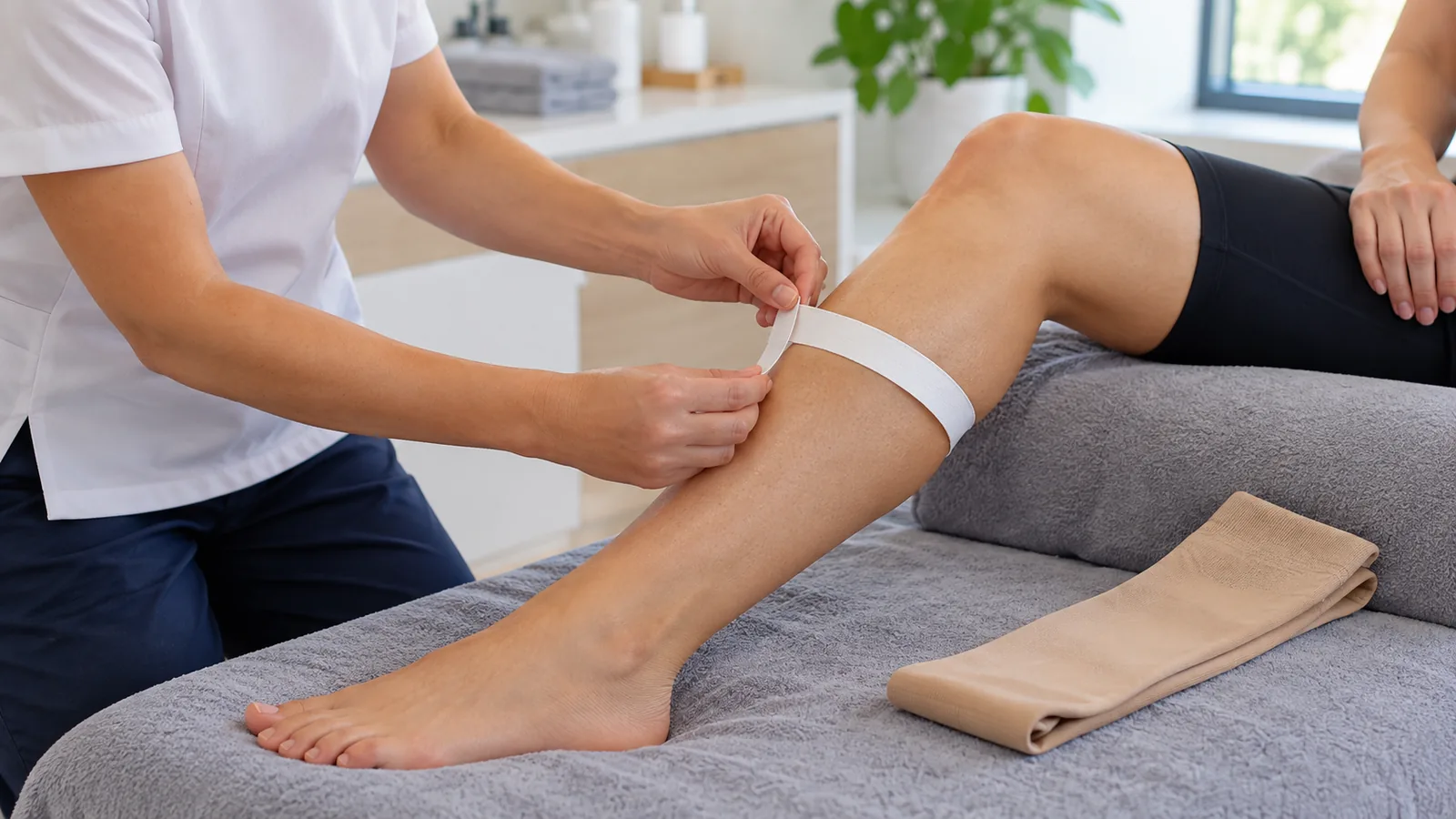
Compression stockings can be a useful support in venous insufficiency, but they are not something to pick off a pharmacy shelf by eye. The right compression class and size are chosen after measuring the leg, and in people with poor arterial circulation the wrong stocking can do harm. That is why we ask you to use them on the advice of a doctor or therapist, properly measured. Losing excess weight, keeping hot baths and saunas short and not baking on hot sand for hours also reduce evening swelling.
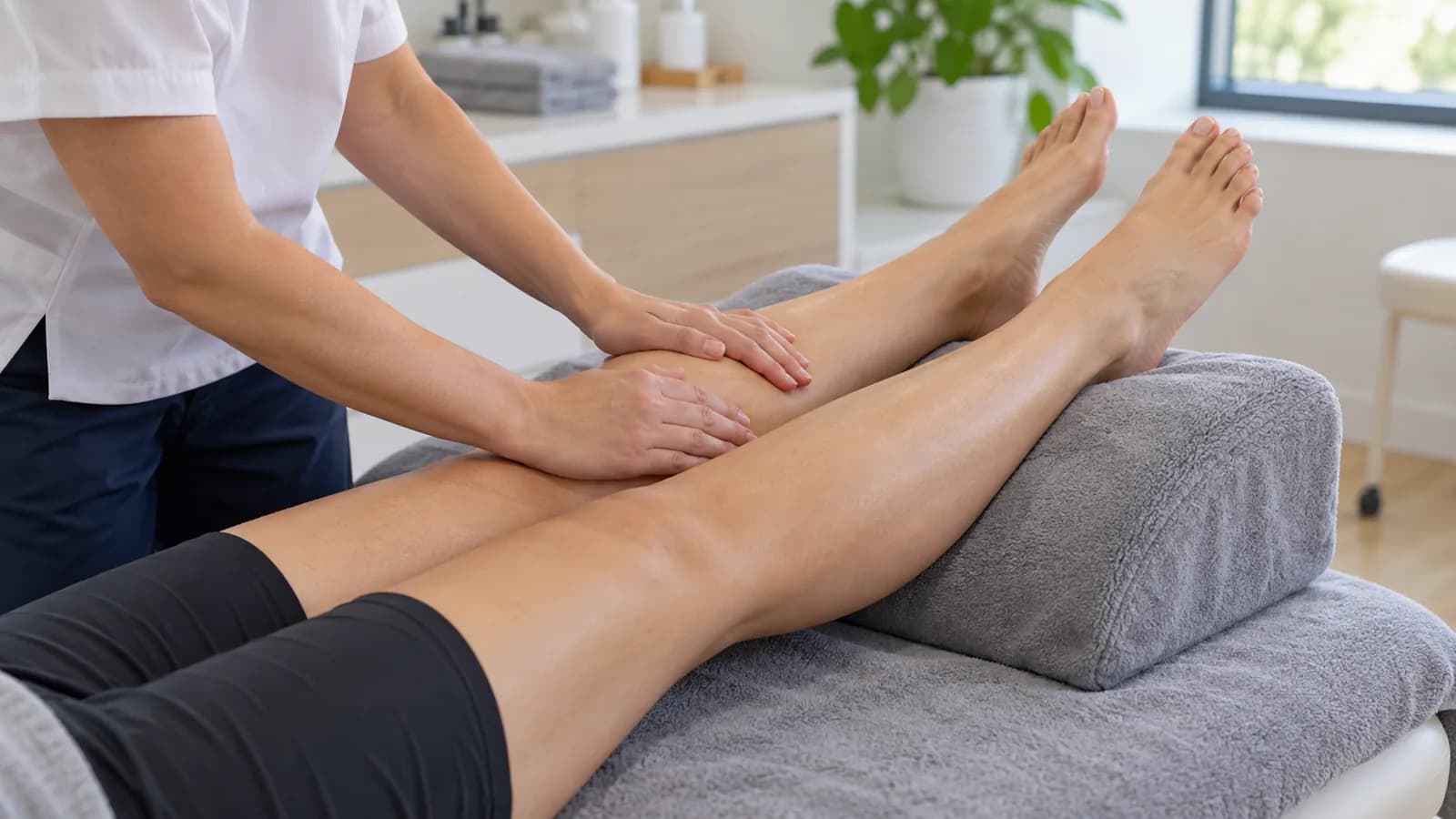
Manual lymphatic drainage is not the main treatment for venous insufficiency. When a lot of fluid has collected in the tissues and the lymphatic system is under strain too, it can temporarily ease swelling and heaviness, and it makes sense when combined with exercise and compression. It does not repair the valves.
The more the calf muscle works, the lighter the leg feels; but no exercise will close a valve that has failed. We can ease the symptoms, while decisions about the vein itself belong to the doctor.
An honest limit: treating varicose veins is a job for a vascular specialist
It needs saying plainly: exercise, compression and drainage relieve symptoms and may help slow progression, but they will not make visible varicose veins disappear. If you have twisted, bulging veins, discoloured skin around the ankle or hardened skin, the assessment belongs with a vascular surgeon. Whether laser treatment, foam sclerotherapy or surgery is appropriate, and when, is the doctor's decision.
Physiotherapy still has a role. Keeping the calf pump strong before and after a procedure, helping you move safely and making your daily routine kinder to your legs is our field. The order of things, however, is agreed with your doctor.
Red flags: do not wait with these
Some types of leg swelling do not fit the usual pattern of venous insufficiency and should not wait:
- Sudden, painful swelling in one leg, with warmth, redness or tightness in the calf. This raises the suspicion of deep vein thrombosis (a blood clot); see a doctor the same day. The risk is higher after a long flight, surgery or a period of bed rest.
- If this comes with shortness of breath or chest pain, call 112 (the emergency number in Turkey) straight away.
- An open wound on the leg that will not heal, especially on the inner side of the ankle.
- Swelling in both legs that appears over a short time, together with breathlessness or unusual tiredness; this can point to the heart or kidneys.
- Swelling with fever and spreading redness of the skin, which may mean an infection.
In these situations massage, drainage or exercise do not come first; a medical examination does.
If your legs feel heavy in the evenings, your socks leave marks around the ankles and this has gone on for more than two weeks, you are welcome to come to our clinic for an assessment. We will work out together where the swelling is coming from, refer you to a vascular specialist if needed, and build an exercise and self-care plan that suits you.