You follow the diet to the letter. The scale moves, your face and waist get slimmer, and your legs stay exactly where they were. On top of that they hurt when touched, and a bruise appears from a knock you do not even remember. We examine a lot of patients who have spent years being told this is a lack of willpower. What they are describing is usually not willpower at all, but a fat tissue disorder called lipedema. Lymphedema and lipedema care is a separate area of work at our clinic in Muratpaşa, and this article gathers the questions our patients ask most often.
What Lipedema Actually Is
Lipedema is a chronic condition in which subcutaneous fat increases symmetrically in specific areas — hips, thighs, calves and often the upper arms. It is not only the volume of fat cells that changes: the small vessels in the tissue become fragile, connective tissue and fluid balance shift, and the area turns painful under pressure. That is why lipedema cannot be filed under "extra weight". The tissue itself is affected.
It is seen almost exclusively in women, and it begins around hormonal transitions: puberty, pregnancy and menopause. A mother, aunt or sister with the same leg shape is a detail we hear about often. Cases in men are rare and usually accompany a hormonal disorder.
One thing has to be said plainly from the start: there is no treatment that removes lipedema completely. What a well-built plan does achieve is far from trivial — pain decreases, volume is brought under control, bruising becomes less frequent, and progression to later stages is slowed. That is exactly what we aim for in the clinic.
Lipedema, Lymphedema and Simple Excess Weight: How to Tell Them Apart

These are the points we look at when separating the three pictures during an examination:
- Symmetry: lipedema is bilateral and symmetrical; the two legs look almost identical. Secondary lymphedema is usually one-sided and creates a measurable difference between the two limbs.
- The cuff sign at the ankle: in lipedema the swelling stops with a sharp line just above the ankle and the feet are spared, leaving something like a trouser cuff. In lymphedema the top of the foot and the toes are involved as well.
- Pain and tenderness: lipedema tissue can hurt on touch, sometimes even under the weight of a bedsheet. Lymphedema typically brings heaviness and tightness rather than pain, and simple excess weight is not tender at all.
- Easy bruising: bruises after contact you cannot recall are common in lipedema and relate to the fragility of small vessels.
- No response to dieting: when weight comes off, the face, chest and trunk get slimmer while the legs stay disproportionate. In simple obesity fat is distributed everywhere including the trunk and reduces in proportion to the weight lost.
- Stemmer's sign: try to pinch and lift the skin at the base of the second toe. In lipedema this skin lifts easily (the sign is negative); in lymphedema it cannot be lifted (positive).
- Pitting: press lipedema tissue for ten seconds and usually no dent remains. In early-stage lymphedema a dent does remain and fills slowly.
The three do not exclude one another. Excess weight can be added on top of lipedema, and if lymphatic transport capacity is overwhelmed over the years, lipolymphedema develops. Examination, circumference measurements and imaging where needed make the distinction together — comparing photographs online does not.
Stages: How the Tissue Changes Over Time
The classification in common use looks at the skin surface and the consistency of the tissue underneath. A stage describes where the tissue has arrived, not how severe the pain is; a stage 1 patient can be in considerable pain.
- Stage 1: the skin surface looks smooth, and small pea-sized irregularities can be felt under it.
- Stage 2: the surface becomes uneven, with an orange-peel or mattress-like appearance, and larger fat nodules become palpable.
- Stage 3: the tissue hardens noticeably, overhanging fat pads form on the inner thigh and around the knee, and walking and knee mechanics begin to suffer.
- Stage 4: lymphedema has been added to the picture (lipolymphedema). The top of the foot swells, Stemmer's sign turns positive, and skin care and infection prevention move to the front.
Alongside the stage, types are described by the area involved: hips and thighs only, down to the knee, down to the ankle, and the arms. Read together, these two axes shape a plan that fits the individual.
Why "Just Lose Weight" Is Misleading Advice
Most lipedema patients arrive at the clinic after years of diet plans. The diet itself is not worthless — excess body fat increases the load on the lymphatic system and makes treatment harder to respond to, so weight management stays part of the plan. The problem is the expectation that lipedema will resolve through dieting.
Affected fat tissue does not respond to a calorie deficit the way trunk fat does. The person loses weight, the leg in the mirror does not change, and they take the failure personally. That loop feeds a heavy body image burden and can open the door to disordered eating; it is why relief is so often the first reaction when we finally name the condition.
The cost of delay is not only emotional. In the early stages compression, movement and regular follow-up can slow progression, while at stage 3 hardened tissue and the load carried by the knees are far harder to reverse. For further reading in English, the NHS page on lipoedema is a clear and reliable starting point.
Treatment: Complete Decongestive Therapy and Its Components

The framework we use in lipedema is the one familiar from lymphedema care, complete decongestive therapy. It has four components, and the point is to run them together within one programme rather than picking one and hoping.
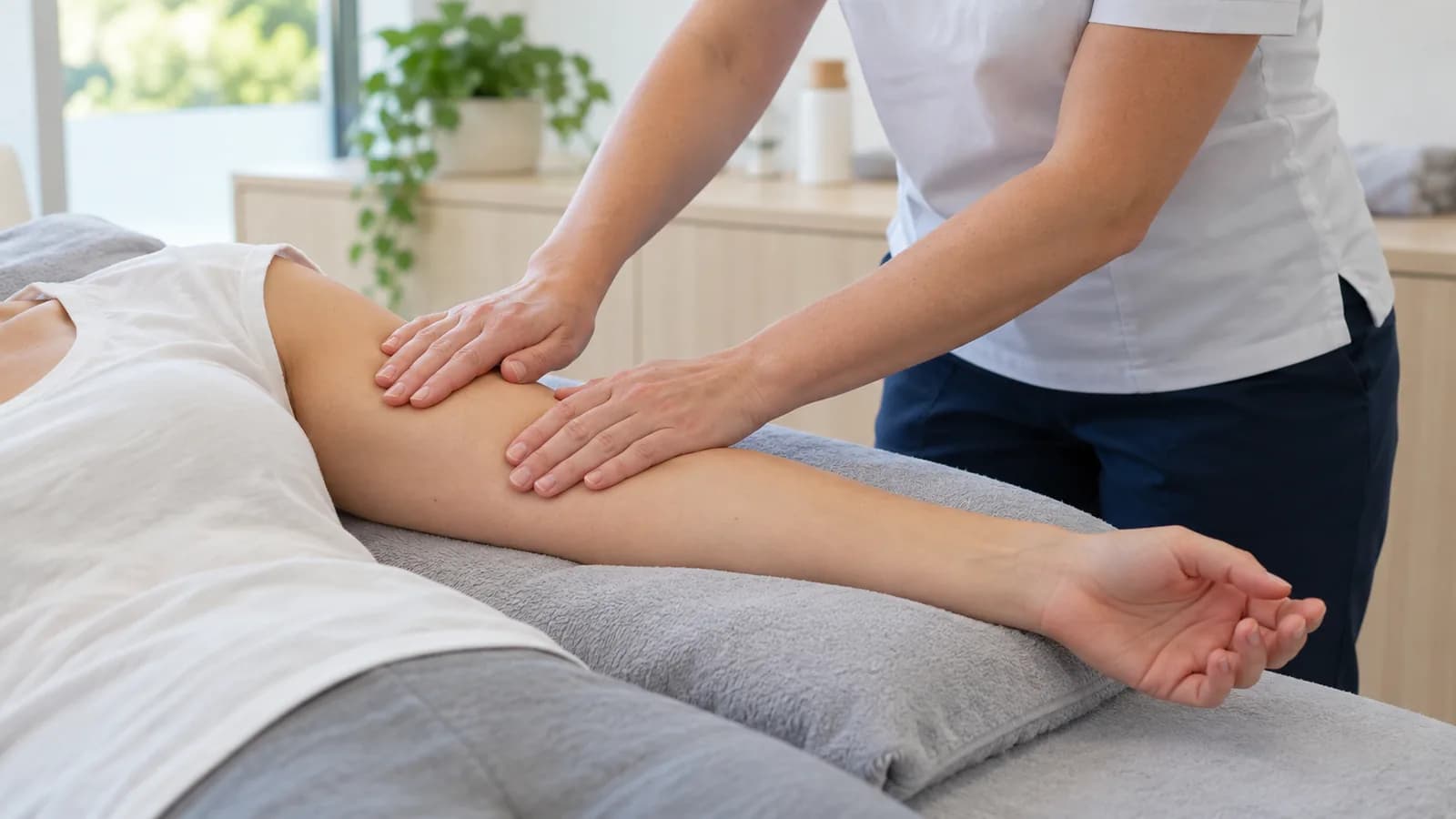
- Manual lymphatic drainage: a hands-on technique that glides the skin under very light pressure without kneading the muscle. Manual lymphatic drainage reduces the fluid component of the tissue; in lipedema the gain patients report most is that tightness and touch pain settle down. Deep massage increases pain in lipedema tissue, so the lightness of the technique is a rule rather than a preference.
- Compression: lipedema calls for a flat-knit garment made to individual measurements. A standard circular-knit stocking from the pharmacy is usually not enough; it cuts in at the ankle and constricts higher up, so it ends up in a drawer.
- Movement and decongestive exercise: exercise performed while wearing compression drives the muscle pump. The same exercise without compression achieves noticeably less.
- Skin care: tight, dry skin cracks, and in later stages fungal and bacterial infections settle in the skin folds. Moisturising and keeping folds dry belong to the daily routine.
Expectations need to be set correctly from the outset. Drainage and compression reduce the fluid component: the leg feels lighter, pain eases, and circumference measurements can drop by a few centimetres. The affected fat tissue, however, does not melt away this route. Saying so openly protects patients from disappointment and from expensive programmes that promise results.
Nutrition, Movement and Daily Life
- Nutrition: the goal is not slimming but a pattern that lowers inflammatory load and the tendency to retain fluid. Cutting back on ultra-processed food, sugar and salt eases the feeling of fullness in the legs for most of our patients. Restrictive, unsustainable diets backfire in this picture.
- Moving in water: walking in a pool and swimming hold a special place in lipedema; the hydrostatic pressure of water acts like natural compression and joint load stays low.
- Low-impact activity: cycling, the elliptical and brisk walking are safe. High-impact sport with jumping can aggravate knee pain in later stages.
- Keep your distance from heat: hammams, saunas and very hot showers dilate vessels and increase swelling and pain. It is the point we repeat most often through an Antalya summer.
- Do not stay standing or seated for long stretches: break it up with a walk, and raise your legs above heart level for a while during the day.
- The emotional load is a real heading: years of being misunderstood leave a mark. Psychological support, where it is needed, makes the rest of the treatment easier to sustain.
A Balanced Note on Liposuction
Lipedema surgery uses specialised liposuction techniques designed to remove affected fat while sparing the lymphatic vessels (tumescent and water-jet assisted methods). It differs from cosmetic liposuction in technique, planning and aftercare.
Who it comes up for: patients whose pain and restricted movement persist despite consistently following a programme of compression, drainage and movement, and whose expectations are realistic. It rarely finishes in one session, it is planned region by region, and in Turkey it is usually paid for out of pocket.
What it does not promise: surgery does not eliminate lipedema. Compression garments, movement and weight management continue afterwards, and the result is not maintained if they are dropped. In inexperienced hands, damage to lymphatic vessels and the addition of lymphedema to the picture is a genuine risk.
The decision belongs to the patient, taken together with a physician who works in this field. The physiotherapy side does not make that call; it handles the preparation before surgery and the swelling management afterwards.
When to Get It Assessed, and Appointments in Antalya
In some situations the priority is a physician rather than physiotherapy. Seek help without delay if you notice:
- Swelling that starts suddenly in one leg with calf pain and tightness: this needs urgent assessment for deep vein thrombosis.
- Redness, warmth and fever over the swollen area: this suggests a skin infection requiring antibiotics.
- Shortness of breath, breathlessness that worsens when lying down, or swelling rising quickly in both legs: cardiac and renal causes need to be ruled out.
- Rapid weight gain over a short period alongside irregular periods and marked hair growth: hormonal assessment is needed.
At Akdeniz Deva we base lipedema follow-up on measurement: circumferences are taken at defined points, the difference between the legs and the pain level are recorded, and the same points are measured again throughout treatment. That way "I feel more comfortable" comes with a number beside it.
The two can also appear together: when lymphatic overload builds on top of lipedema over the years, the character of the swelling changes. Our article on the early warning signs of lymphedema and complete decongestive therapy describes how we recognise that shift. In lipedema, movement matters not for losing weight but for easing pain and tension in the tissue; the warm-up and recovery rules in our article on managing physical load safely apply to painful legs as well.
If the fullness in your legs does not respond to dieting, hurts when touched or bruises easily, let us separate the picture together. You can book an appointment at our clinic in Muratpaşa and bring any reports you already have. What we do at the first visit is work out whether this is lipedema, lymphedema or something else, and refer you to the right physician if that is what is needed.
This article is for information only; it does not replace an examination or an individual treatment plan.