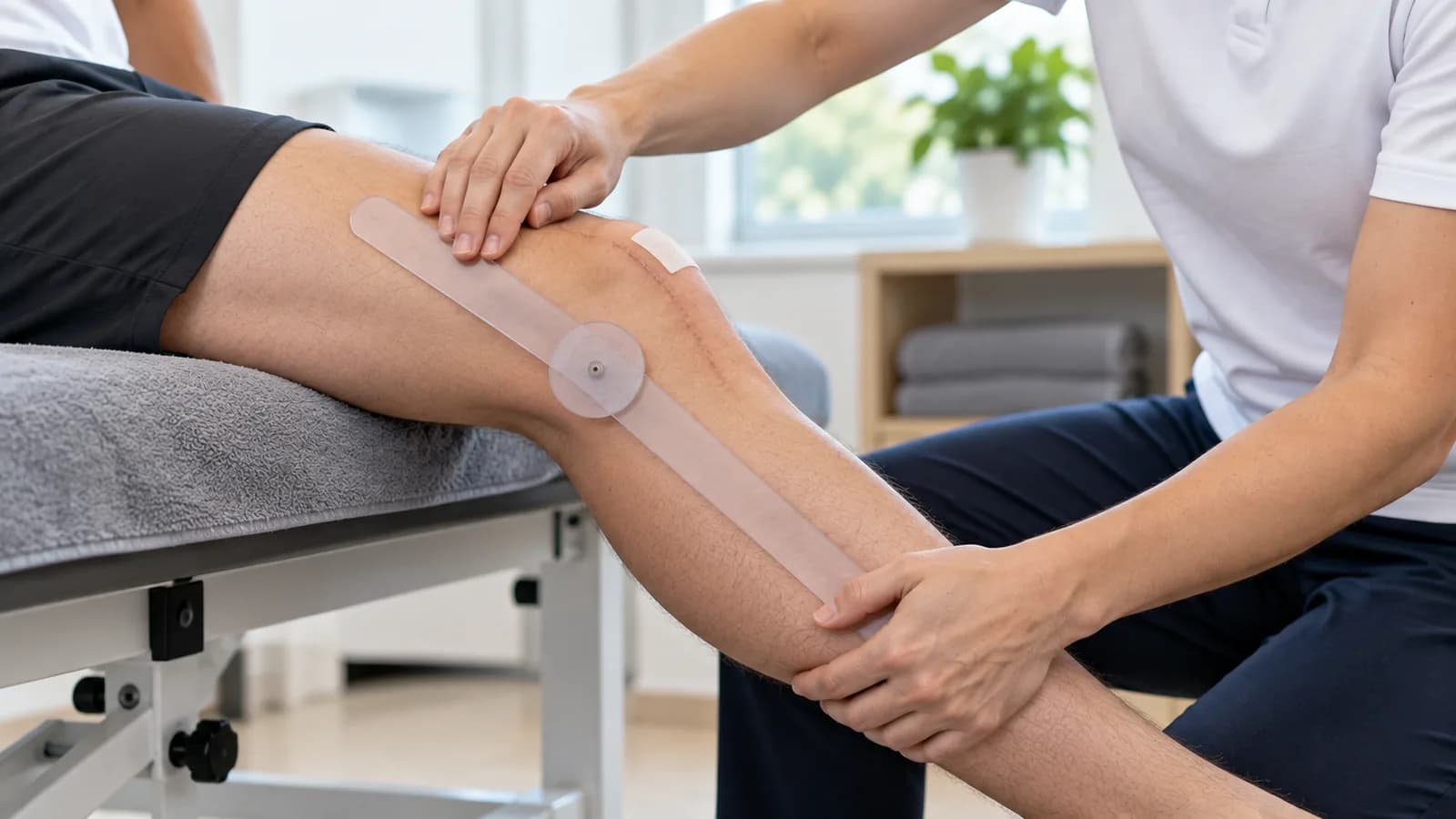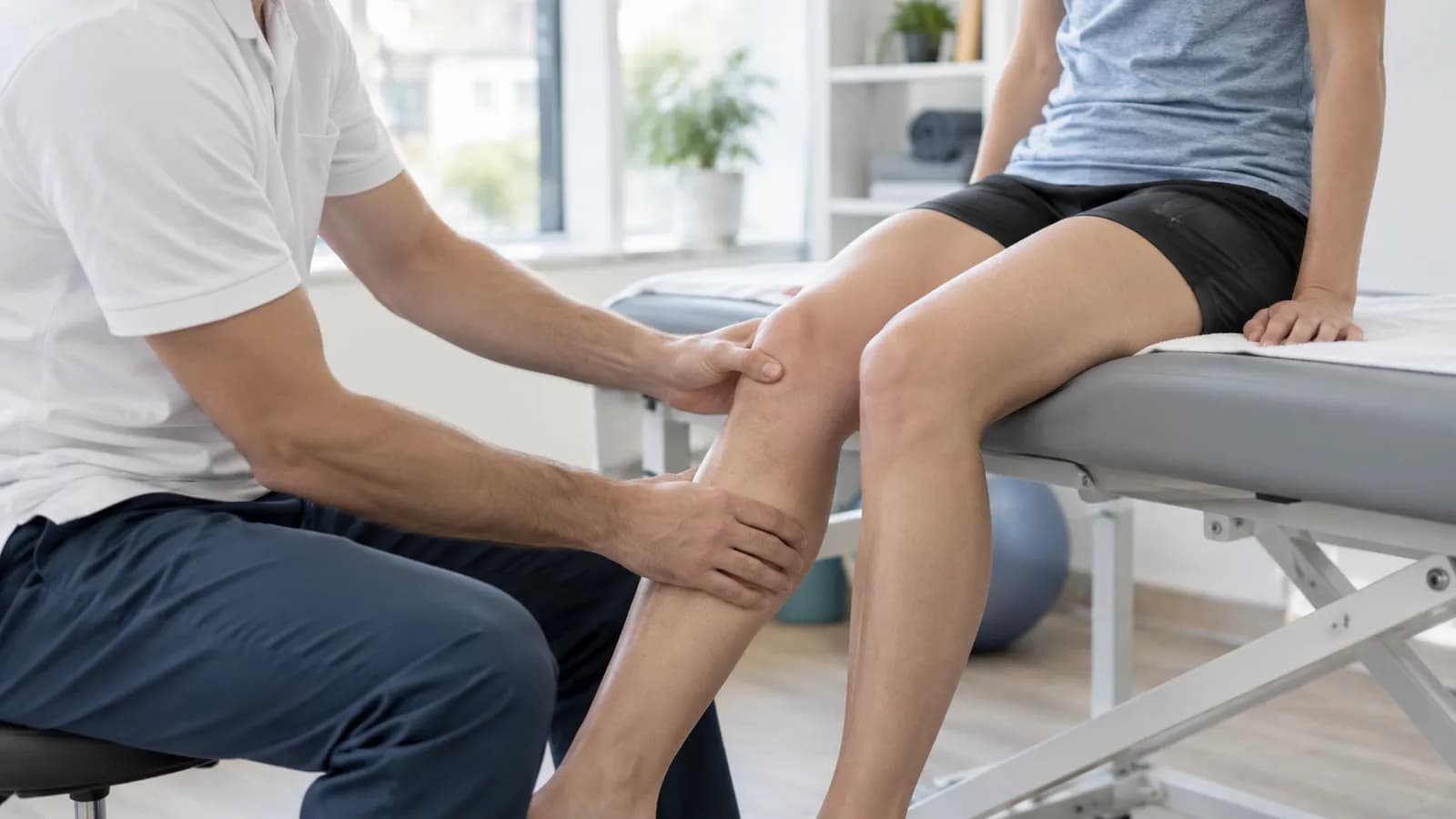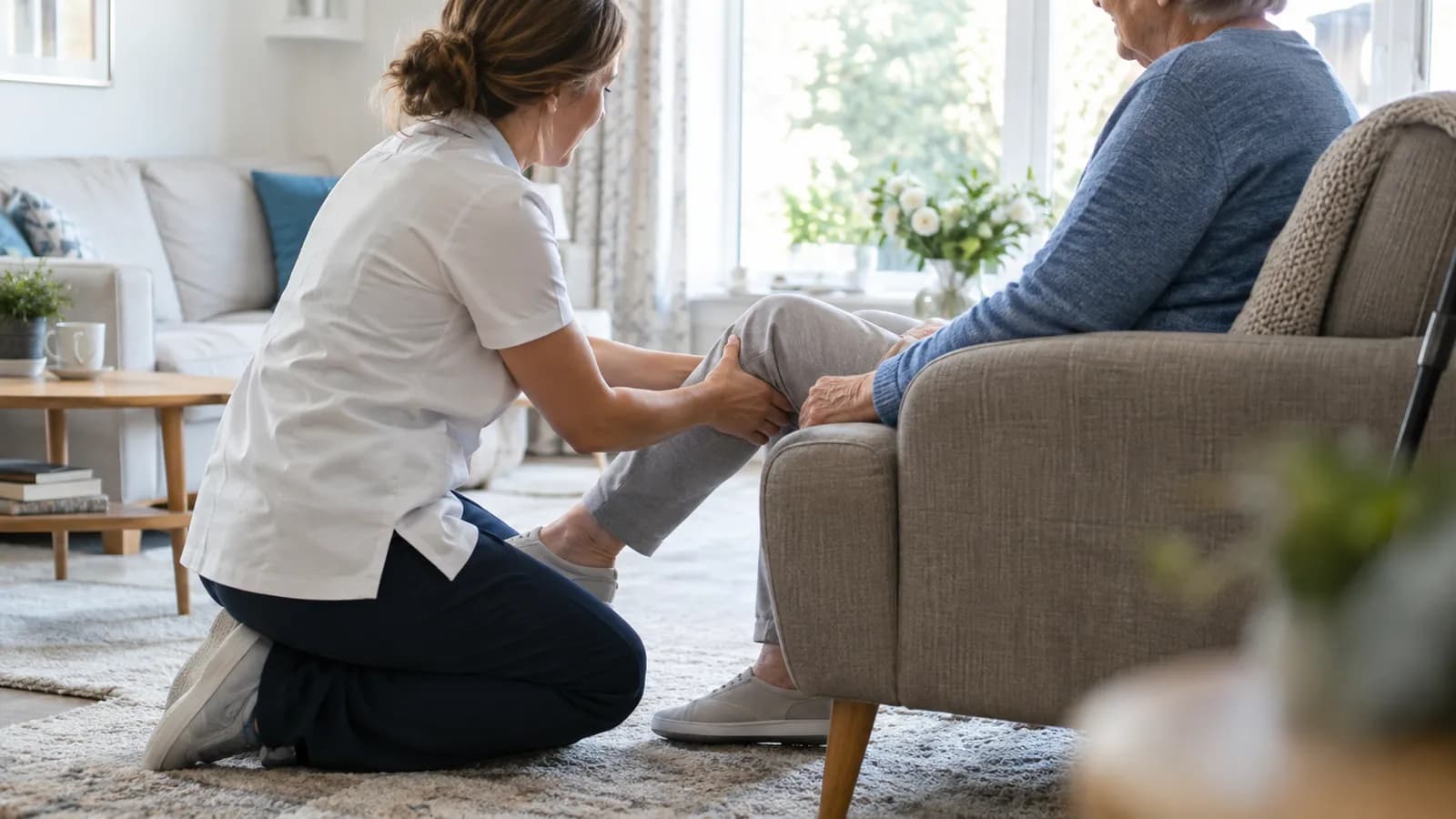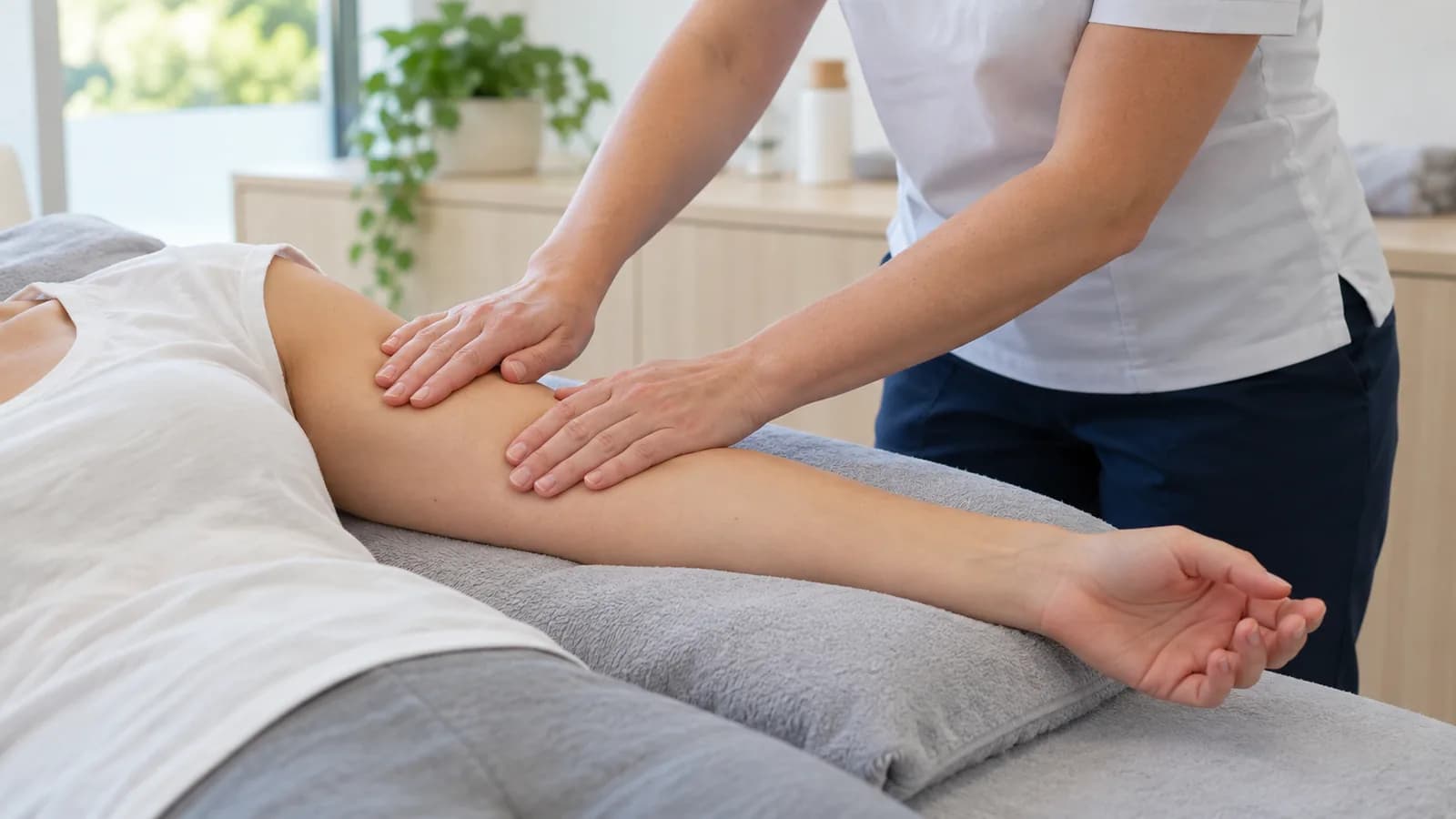
"My ring has started to feel tight, and I struggle to get it off in the evening." "My bra strap leaves a deeper mark on my shoulder than it used to." "My arm feels heavy, but when I look at it, it doesn't seem swollen." These are the sentences we hear most often from women who have finished breast cancer treatment. Very often there is no visible swelling yet. The sensation comes first: fullness, tightness, tingling, an arm that tires more quickly than before.
Here we look at arm lymphedema after breast cancer treatment: why it develops, why the early phase matters, what we measure and what to watch for in daily life. For the general picture, including leg lymphedema and how the lymphatic system works, see our article on lymphedema and manual lymphatic drainage.
One thing first: noticing these symptoms is not your fault. Lymphedema is a possible consequence of a treatment meant to save your life, and it is far easier to manage when caught early.
Why does it happen? Lymph nodes in the armpit and radiotherapy
Lymph fluid from the arm, the chest wall and the breast returns to the circulation largely through the lymph nodes in the armpit, the axillary nodes. Treatment in this area can narrow that route.
In a sentinel lymph node biopsy, only the first one or few nodes are removed. In an axillary lymph node dissection, a larger share of the nodes in the armpit is taken out. That is why the risk of lymphedema is lower after a sentinel biopsy, although it is not zero. Radiotherapy to the armpit and surrounding area can also cause the lymph vessels to narrow and stiffen over time, and the risk rises when surgery and radiotherapy are combined. Weight gain and infections in the arm during treatment are other factors that can play a part.
What surprises patients most is the timing: lymphedema can begin soon after surgery, or months and even years later. The thought "my treatment ended three years ago, so it won't happen now" is therefore misleading. Sometimes there is a trigger, such as an infected insect bite, unusually heavy work or a long flight. Sometimes no cause can be found at all.
Why the early phase matters so much
Lymphedema is not a fixed condition; it can progress over time. In the early stage the tissue is soft. When you press it with a finger, a dent remains for a while, and the arm feels clearly better in the morning after a night's rest. At this point what has built up is mostly fluid, and early-stage swelling responds much better to treatment.
If the swelling goes unnoticed or untreated for a long time, the picture changes. The protein-rich fluid trapped in the tissue gradually leads to thickening and hardening of the connective tissue, known as fibrosis, and fatty tissue increases. At this stage pressing no longer leaves a dent, rest does not reduce the swelling and the skin thickens. Advanced lymphedema can still be treated and brought under control, but the road is longer and the gains are more limited.
The patient we are always happiest to see is the one who comes early, saying "maybe I'm wasting your time." A measurement that turns out to be unnecessary is always better than a missed early phase.

What we measure in the clinic
You cannot follow lymphedema with "my arm feels a bit swollen"; it is tracked in numbers. At the first visit we measure both arms side by side. Starting at the wrist, we take circumference measurements with a tape at defined points, the same points every time, and use them to calculate the volume of the arm. Your unaffected arm serves as your own reference. Because there are often small natural differences between the two arms, the change over time matters more than any single measurement.
We also examine the tissue by hand: does pressing leave a dent, has the skin thickened, is there fullness in the fingers and the back of the hand, is there hardness or a tight, cord-like band in the armpit or on the chest wall? We also record how freely your shoulder moves, because stiffness after surgery affects both everyday life and lymph flow. We repeat the same measurements throughout treatment, so you and your oncologist have a concrete picture.
Having both arms measured before surgery or soon after it is a real advantage. If those measurements don't exist, don't worry; the values from your first visit become the starting point for everything that follows.
At home, a few simple notes help: how tight the same ring or watch feels, how visible the strap mark is in the evening, how the arm feels morning versus evening. They don't replace measurement, but they help us see what changed and when.
Complete decongestive therapy: a two-phase process
The physiotherapy approach most widely accepted for lymphedema today is complete decongestive therapy (CDT). It is not a single technique but five components that work together: manual lymphatic drainage, multi-layer compression bandaging, a compression garment, exercise and skin care. At our clinic we deliver this within our complex therapy programme, planned individually for each patient.
The first phase is the intensive, or reduction, phase. Manual lymphatic drainage is carried out at close intervals, and afterwards the arm is wrapped in a multi-layer bandage whose pressure decreases from the hand towards the shoulder. Patients are often hesitant about the bandage, yet it is what holds each session's gain until the next day. Manual lymphatic drainage is a light, slow and rhythmic technique that guides fluid away from the damaged area towards lymph pathways that still work, for example towards the opposite armpit or the groin on the same side. It is not a deep, strong massage, and it should not be.
The second phase is the maintenance phase. Once the arm has reached a certain level, the bandage is replaced by a made-to-measure compression garment: a sleeve and, if needed, a glove or hand piece. An off-the-shelf sleeve sometimes works, but sometimes it squeezes in the wrong place and pushes the swelling into the hand or elbow. That is why a compression garment should always be fitted to measurements, taken when swelling is at its lowest, ideally in the morning. With daily wear the fabric loses elasticity, so the garment needs replacing every few months and re-measuring whenever the arm volume changes. In this phase we also teach simple self-drainage movements and exercises you can do at home.
Exercise, lifting and daily life in Antalya
For many years women who had breast cancer surgery were told: "Don't lift anything with that arm." That view has changed. Research shows that controlled, gradually increased resistance exercise can be safe for many women who have lymphedema or are at risk of it. An arm that is never used weakens, the muscle pump that moves lymph slows down and everyday tasks become tiring. That does not mean starting with heavy weights at the gym. Exercise is tailored to you, starts with low loads, is often done while wearing the compression garment, and is increased step by step while the arm measurements are monitored. Starting with your oncologist's knowledge and under a therapist's supervision is the safest route.
Living in Antalya brings its own challenges. The heat of July and August widens the blood vessels and can increase fluid build-up in the arm. A problem we often hear from patients working in tourism is wearing a sleeve under a tight hotel uniform, and an arm that feels heavy at the end of a shift spent carrying trays, linen or luggage. For patients who fly in for treatment or a holiday, sitting still for hours on a long flight adds extra strain. In daily life we suggest paying attention to the following:
- Moisturise your skin every day and protect it from cuts, scratches, burns and insect bites. Wear gloves in the garden and the kitchen, and don't forget insect repellent on summer evenings.
- Don't have your cuticles cut during a manicure; use an electric razor rather than a blade to shave the armpit.
- On the affected side, avoid tight rings, watches, bracelets and clothing that constricts the arm; make sure your bra strap does not dig into your shoulder.
- Avoid excessive heat: long hammam and sauna sessions, scorching beach sand at midday and sunburn all put strain on the arm. Swimming in cool sea water, on the other hand, is often good exercise.
- On long flights, wear your compression garment if your doctor or therapist recommends it; drink water and move your hand and arm regularly during the journey.
- Many centres advise having blood taken, cannulas placed and blood pressure measured on the other arm where possible; tell healthcare staff about your situation.
When to see a doctor straight away
Some symptoms belong with a doctor, not a physiotherapist. If any of the following occurs, don't wait for your drainage appointment:
- Redness, warmth or pain in the arm or chest wall, together with fever or chills. This suggests a skin infection called cellulitis or erysipelas; it needs antibiotic treatment, and infection can make lymphedema worse quickly.
- Swelling that increases rapidly over a few days without any clear reason.
- Painful, tense swelling with a change in colour in one arm; a blood clot (thrombosis) needs to be ruled out.
- A new lump or area of hardness in the armpit, on the chest wall or in the neck.
Manual lymphatic drainage is not performed while an infection is active, and no bandage is applied; we resume treatment once your doctor gives the go-ahead. The same rule applies when a blood clot is suspected.

Being honest: a chronic condition that can be controlled
In most cases lymphedema is not something that disappears completely; it is a chronic condition that can be brought under control. During the intensive phase the arm volume can fall noticeably, the heaviness eases and movement becomes easier, but keeping those gains depends on compression, exercise and skin care becoming part of everyday life. Be cautious of any approach that promises "it will be gone in a few sessions". In some patients with advanced lymphedema and marked fibrosis, physiotherapy alone may not be enough; in that case we refer you to the appropriate specialist to discuss options such as lymphedema surgery.
Physiotherapy does not replace oncological follow-up; it works alongside it. Keep your check-ups and tell your oncologist about any change in your arm. For a neutral, patient-friendly overview, you can read the NHS page on lymphoedema.
If, after breast cancer treatment, your ring has started to feel tight or your arm feels heavy, and this has lasted more than two weeks, you are welcome to visit our clinic for a side-by-side measurement of both arms and an assessment. If there is redness, warmth or fever in the arm, please see your doctor first.