What pregnancy and birth did to your core
For nine months your abdominal wall and your pelvic floor carried a growing baby. The straight muscles at the front of the abdomen (rectus abdominis) stretched sideways, and the connective tissue between them (the linea alba) thinned out. The pelvic floor absorbed both the added weight and the strain of delivery.
That is adaptation, not damage. But adaptation does not reverse on its own; the body has to relearn how to carry load. Back pain that lingers months after birth, a belly that still pushes forward, leaking when you sneeze — these usually come from missing coordination rather than from muscles that are simply “weak”.
Most of the mothers who come to our clinic in Antalya say the same thing: “They told me it would pass, and it didn’t.” What is usually missing is not time, but guidance.
What is diastasis recti, and how do you check it at home?

Diastasis recti is the separation of the two straight abdominal muscles as the connective tissue along the midline thins. Some degree of separation is present in most women right after birth. The real question is whether the gap narrows over the following weeks and whether the midline can hold tension under load.
You can get a rough idea at home:
- Lie on your back, knees bent, feet flat on the bed or mat.
- Place your fingertips just above the navel, across the midline of your abdomen.
- Lift your head and shoulders a few centimetres off the pillow — slowly, not with a jerk.
- Notice how many finger widths sink into the gap. Repeat three finger widths above and three below the navel.
One to two finger widths is common and is not a problem in itself. A gap of two and a half fingers or more, or one where your fingers sink deep and the midline feels hollow, deserves an assessment. Depth matters more than width: if the gap is narrow but the floor under your fingers is soft, the load is still landing on the midline.
This check is not a diagnosis. What you find is simply information to bring with you to your appointment.
Which movements to avoid in the first months
Any movement that sharply raises intra-abdominal pressure pushes down on a healing midline and pelvic floor. Going back to those movements before the separation closes creates a cone-shaped bulge along the midline and sets the process back.
Avoid these in the early stage:
- Classic abdominal work: sit-ups, crunches, scissor kicks.
- Straight support positions where the abdomen carries the whole load, including planks and push-ups.
- Heavy lifting, especially any effort made while holding your breath.
- High-impact jumping exercises and running; if you are leaking, postpone these entirely.
- Straining on the toilet. If you are constipated, do not just live with it — raise it with your doctor.
This is not a ban on exercise; it is a matter of sequence. In their place come breath-synchronised deep abdominal and pelvic floor work, side-lying hip exercises and walking. Get the order right and you will not need sit-ups at all.
Pelvic floor symptoms: common does not mean permanent
The pelvic floor does not stay quiet when it is overloaded. These are what we hear most often from new mothers:
- Leaking urine when you cough, sneeze, laugh or lift something
- Heaviness or pressure in the vaginal area, or a sense that something is coming down
- Pain, burning or discomfort during intercourse
- Persistent pain in the lower back, tailbone or groin
- Frequent trips to the toilet, urgency, or the feeling that the bladder never empties fully
- Leaking wind or stool
Leaking after birth is common — but it does not have to be permanent. “You’ve had a baby, that’s how it is” is a habit, not medical advice. The pelvic floor is a muscle like any other: it responds to training when the training is correct. That is exactly where our pelvic floor rehabilitation programme starts.
Your breath and your pelvic floor work as one team
The diaphragm and the pelvic floor are the ceiling and the floor of the abdominal cavity, and they move together. As you breathe in, the diaphragm descends and the pelvic floor lengthens slightly. As you breathe out, the diaphragm rises and the pelvic floor recoils.
So in a mother who constantly holds her stomach in and breathes shallowly from the chest, the pelvic floor stays tense all day. A tense muscle is not a strong muscle; leaking sometimes comes from an inability to release rather than from weakness.
Building the programme from here works: lengthen with the breath first, then contract. Mothers who learn this connection during pregnancy start a step ahead afterwards — it is also the backbone of our prenatal Pilates sessions.
How to do a Kegel properly — and the three most common mistakes

A Kegel is a conscious contraction and release of the pelvic floor muscles. A correct contraction feels like this: as if you were holding back urine and wind at the same time, draw the area between the pubic bone and the tailbone inwards and upwards. Your abdomen, buttocks and legs stay still.
How to practise:
- Contract as you breathe out, hold for three to five seconds, and keep breathing while you hold.
- Release fully for at least as long as you held; the release matters as much as the squeeze.
- Do sets of eight to ten repetitions, two or three times a day.
- Over the following weeks extend the hold, and add a few fast, short contractions — that is the one that has to fire the moment you cough.
The three most common mistakes:
- Holding your breath. Holding the breath while you squeeze raises intra-abdominal pressure and pushes the pelvic floor down — the opposite of what you want.
- Squeezing the buttocks, abdomen or thighs. If neighbouring muscles take over the job, the pelvic floor never works.
- Testing it by stopping your urine stream. This is not a test. Done regularly it disturbs full bladder emptying and increases the risk of infection. Do not practise on the toilet.
There is a fourth one: finding the wrong muscle and then training it patiently for weeks. A large share of women cannot produce a correct contraction from a verbal description alone. That is why we check at the first assessment whether the contraction is genuinely correct.
After a caesarean: scar tissue and the healing timeline
“I had a caesarean, so my pelvic floor is fine” is a common assumption. It is partly true, but the nine months of load were already there. On top of that come an incision in the abdominal wall and a scar that has to heal.
A scar can adhere to the layers underneath as it heals. Adhesions show up as a pulling sensation in the lower abdomen, back pain, a bulge above the scar line, and deep abdominal muscles that switch on late. Scar mobilisation, started once the incision has fully closed — usually from week six and with your doctor’s approval — changes that picture noticeably.
When can you start? After a vaginal birth, breathing work and gentle pelvic floor contractions can begin within the first days, within the limits of pain. After a caesarean the early phase is limited to walking and breathing; loaded exercise waits for the six-week check and medical clearance. That clearance is not a formality: bleeding, wound healing and the state of the sutures are things we cannot assess from the outside. The American College of Obstetricians and Gynecologists’ guidance on exercise after pregnancy is likewise built on a gradual return and individual approval.
A postpartum recovery timeline and a safe return to activity
Postpartum recovery runs at a different pace for every woman. The type of birth, how much you bled, your sleep, breastfeeding and your fitness before pregnancy all shift the picture. The ranges below are a rough frame, not a promise:
- The first six weeks. The most delicate phase of tissue healing. The aim is pain-free breathing work, gentle pelvic floor contractions, short and frequent walks, and lifting the baby with good mechanics. Postnatal bleeding continues while gradually easing.
- Weeks six to twelve. After the medical check, deep abdominal and pelvic floor work becomes progressively harder; scar mobilisation after a caesarean starts here. Leaking should be clearly less by the end of this window.
- Months three to six. The strength and loading phase: squats, hip work, controlled weights. For most mothers a return to running comes up in this range at the earliest, and only if there are no symptoms.
- Months six to twelve. The abdominal wall and connective tissue keep recovering, and tissue elasticity can shift while you are still breastfeeding. Do not wait for leaking that lasts beyond a year, or a separation that has not closed, to resolve on its own.
A safe return to activity is graded by these signs rather than by the calendar:
- Can you complete a brisk 30-minute walk without pain, without leaking and without heaviness the next day?
- Does the midline of your abdomen cone up during exercise? If it does, the load is still too high for you.
- Do you leak when you cough, sneeze or lift the baby?
- Can you stand on one leg for ten seconds and then do ten hops on the spot? Do not go back to running until both are pain-free and leak-free.
- Bleeding that increases or restarts the day after exercise is a sign to step back one level.
At each new step, increase only one variable: duration, distance or weight. Raising all three in the same week is the most common reason for a setback.
What we do at the clinic, and when to call your doctor
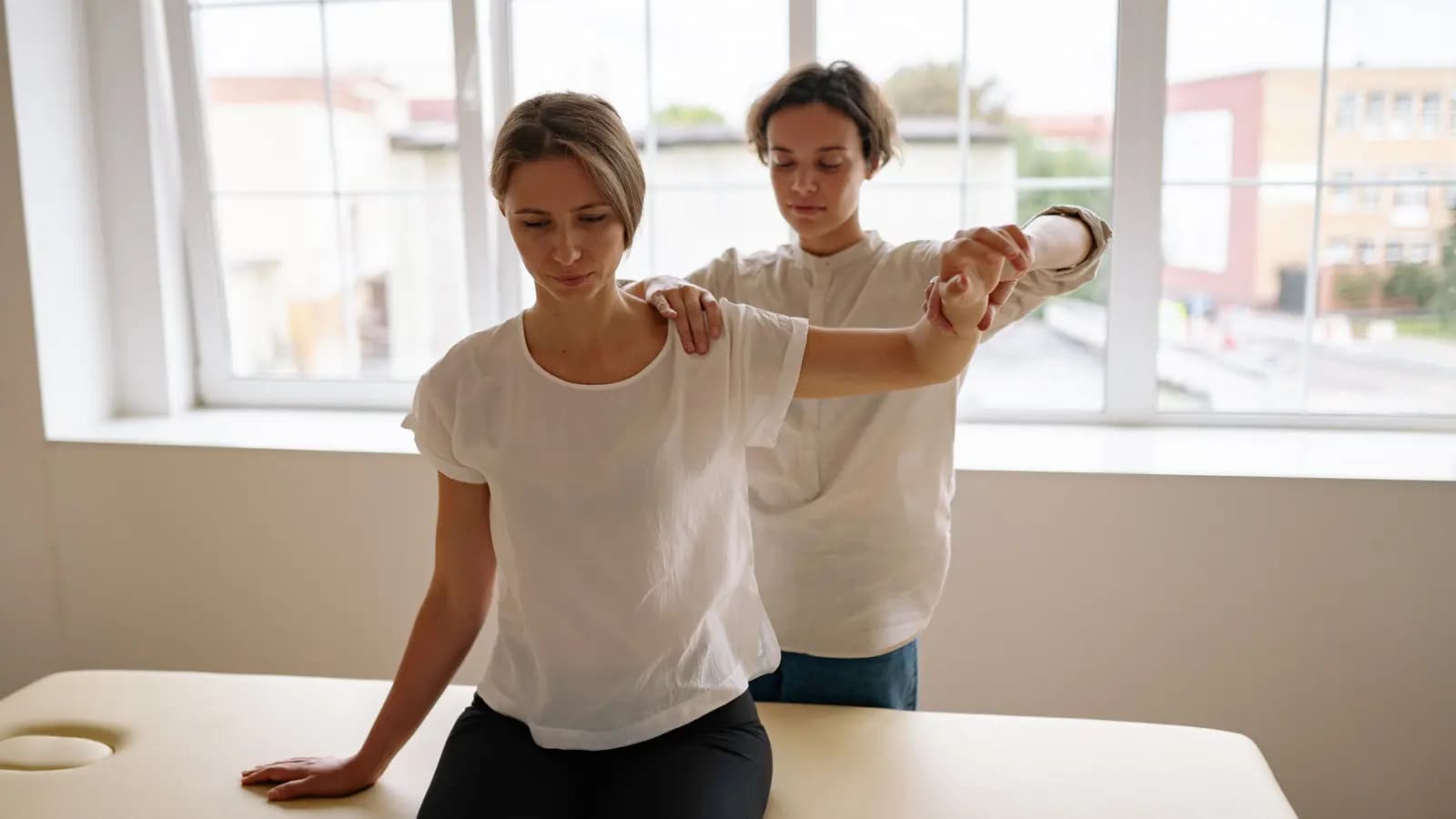
At Akdeniz Deva a postnatal assessment starts with an examination: measuring the diastasis for both width and depth, analysing posture and breathing pattern, checking whether the pelvic floor contraction is being performed correctly, and taking a history of pain and leakage.
The programme is then built around you: breath and deep abdominal coordination, graded pelvic floor work, scar mobilisation where needed, everyday mechanics (lifting the baby, feeding positions, getting out of the car), and finally controlled loading. For mothers who struggle to feel the contraction, we use biofeedback so you can see on screen whether the muscle is actually working.
In the following situations, put the exercises aside and contact your doctor:
- Bleeding heavy enough to soak a pad quickly, or bleeding that restarts after it had settled; large clots
- Fever above 38 °C, chills, foul-smelling discharge
- Redness, discharge or opening at the incision or stitches
- Severe or worsening abdominal pain, a headache that will not go, blurred vision
- Swelling, warmth and pain in one leg; shortness of breath, chest pain
- Leaking wind or stool
- Feeling or seeing a bulge at the vaginal opening (possible prolapse)
The most common mistake after birth is returning to the old training load with a body that is not ready for it; the framework in our article on progressing load gradually lets you advance your pelvic floor programme safely too. Abdominal separation and a weakened pelvic floor increase the load on your lower back directly, so if back pain persists after birth, the daily adjustments in our article on the mechanical causes of back pain will be useful.
Postnatal recovery is not something to leave to chance. A single assessment can tell you whether there is a separation, where the leaking is coming from and what your first step should be. You can book an appointment at our clinic in Muratpaşa, Antalya — we take the measurements at the first visit and map out your weekly plan together.
This article is for information only and does not replace a medical examination. Get your doctor’s clearance before starting postnatal exercise, and see a physiotherapist for a personal assessment if your symptoms persist.