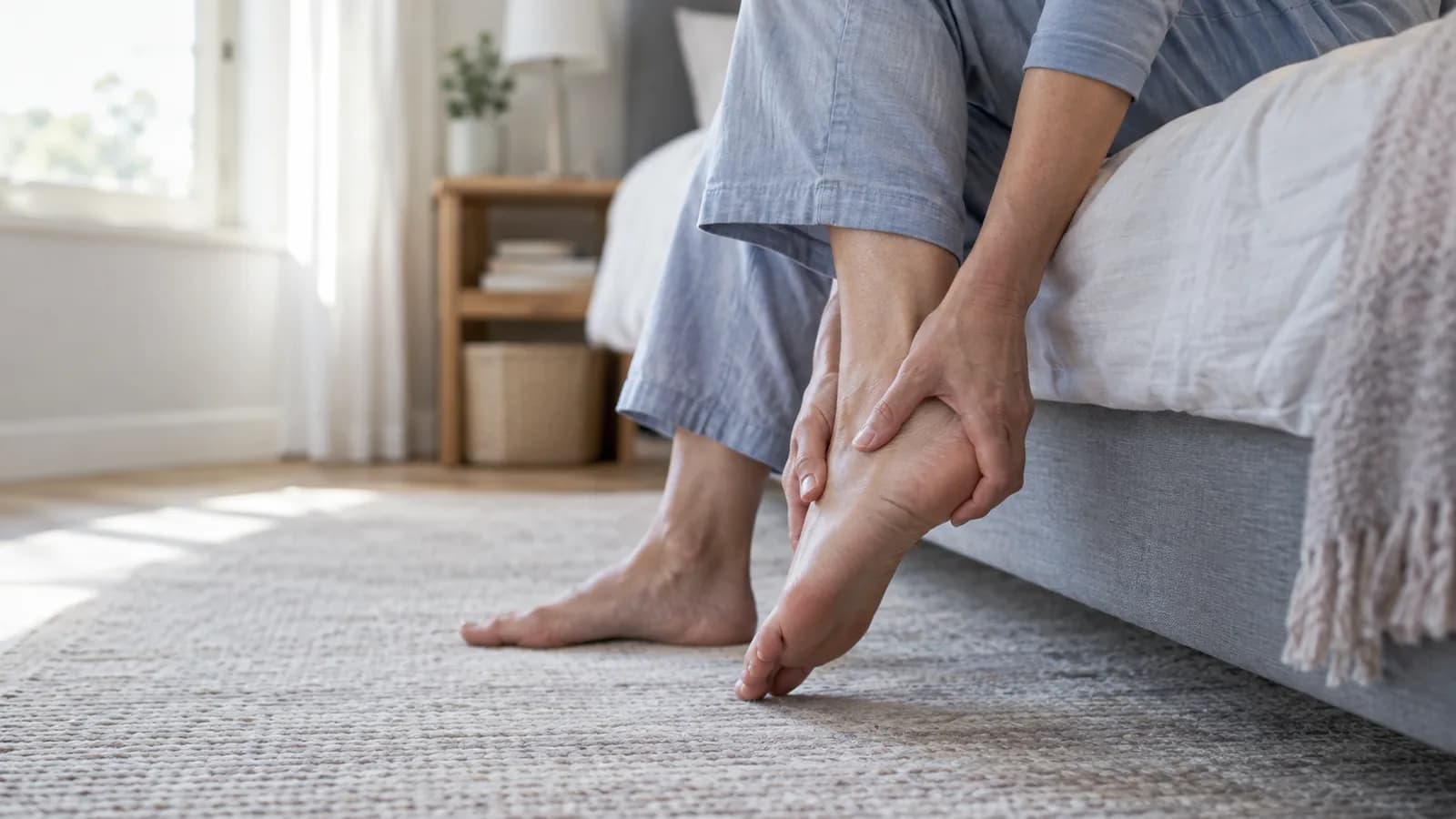
The alarm goes off, you swing your legs out of bed, and before the second step something stabs into your heel. A few minutes later it eases, so you let it go. Then you notice the same pain after sitting at your desk, and again in the evening after a long day on your feet.
Most of the heel pain we see in the clinic starts exactly like this. And almost every patient arrives holding an X-ray: “I have a heel spur.” That is rarely where the problem is.
What plantar fasciitis is and what the fascia does
A thick band of connective tissue runs along the sole of your foot, from the heel bone to the base of the toes: the plantar fascia. Its job is simple but critical — it keeps the arch of the foot under tension, like the string of a bow, and transfers the load from your heel forward to your toes with every step.
That band stretches and releases once per step. For someone walking 8,000 steps a day, that is a serious number of repetitions on a single piece of tissue. When the load outpaces the tissue’s repair rate, irritation begins in the narrow zone where the fascia attaches to the heel bone. That is plantar fasciitis.
So what is a heel spur?

If an X-ray shows a small bony projection pointing forward from the underside of the heel bone, that is called a heel spur. The image is real. But let us be clear: the spur is usually not the cause of your pain.
Plenty of people have a visible spur on X-ray and no symptoms at all — and never develop any. The reverse is just as common: a large share of patients with severe heel pain have no spur on film. The two do not line up.
The spur is the bone’s adaptive response to years of traction in that area. It is a consequence, not a cause — and usually a silent one. What produces pain is overload and irritation at the fascia’s attachment.
This distinction drives the treatment. Our goal is not to “dissolve” the spur; it is to reduce the load on the fascia and give the tissue room to recover. When a patient gets better, the spur is still there on a follow-up X-ray — the pain is not.
Recognising the symptoms: the pattern the pain follows
We usually recognise plantar fasciitis from the history, before we even examine the foot. It looks like this:
- The first 5-10 steps out of bed in the morning are the worst — a sharp, stabbing pain toward the inner front of the heel.
- After a few minutes of walking it softens, sometimes disappears completely.
- Sit at a desk for half an hour, stand up, and the same sharp pain is back.
- If you have been on your feet all day, it builds again in the late afternoon — but as a broad, throbbing ache rather than the morning stab.
- It concentrates not in the middle of the heel but closer to the inner edge. Press there with a thumb and the patient says, “that is exactly the spot.”
- In some patients it does not stay in the heel but spreads forward along the arch of the foot — they usually describe it as arch pain.
The morning pain has a mechanical explanation. During sleep the ankle drops into a pointed position and the fascia repairs itself in a shortened state. The first step stretches that tissue abruptly and stresses the fresh, fragile repair.
What contributes to heel pain
- Weight gain. Even a few kilos noticeably increase the load the fascia carries on every step.
- Flat feet — or the opposite, a very high arch. Both distribute load unevenly across the fascia.
- Long hours standing: waiting staff, hairdressers, nurses, shop assistants, teachers, site workers.
- Thin-soled shoes with no heel support. Months of flip-flops through an Antalya summer is one of the most common triggers we see.
- Tight calf muscles. Traction through the Achilles tendon pulls directly on the heel bone at the fascia’s attachment; it is one of the first things we test.
- A sudden jump in training load: going from 3 km a week to 12, starting a new sport, or walking 15,000 steps a day on holiday.
Everyday care: what you can do at home

In the first two to three weeks the following makes a clear difference for most patients. Follow the doses exactly — an under-dosed exercise is an exercise that does not work.
Calf stretch against a wall. Hands on the wall, painful leg behind you, heel flat on the floor, lean forward from the body until you feel a stretch at the back of the calf. Hold 30 seconds, 5 repetitions, twice a day. Then repeat the whole set with the back knee slightly bent — that version reaches the deeper calf muscle.
Plantar fascia stretch, seated. Sit on a chair and cross the painful foot over the opposite knee. Grip your toes and pull them back toward the shin; with the other hand feel the band tighten along the sole. Hold 30 seconds, 5 repetitions. Do this before you get out of bed, before the first step of the day — it is the single most effective thing for morning heel pain.
Frozen bottle roll. Freeze a half-litre plastic bottle of water. Sitting down, roll the sole of your foot over it from heel to the base of the toes and back. Ten minutes, once or twice a day, ideally at the end of the day.
Footwear and heel support. Stop walking barefoot or in thin slippers indoors — the house is where this pain is fed. Choose a shoe with a slightly cushioned sole, a heel 1-2 cm higher than the forefoot, and a closed back, and wear it at home too. A gel heel pad from the pharmacy helps spread the load in the early weeks; it is a bridge, not a cure.
Managing your walking load. Do not stop walking altogether — adjust the amount. The rule: pain during the walk should stay at or below 3 out of 10, and the next morning must not be worse than the day before. If it is, cut the distance by a third, hold that for three days, then build up gradually. Prefer even surfaces over hard, uneven ground.
Professional assessment: what we do in the clinic
We start with assessment: the exact painful point, arch shape and loading pattern, ankle range of motion (particularly the calf-tightness test), knee and hip mechanics, and the wear pattern on the sole of your shoe. Heel pain does not always start in the foot — weak hip muscles can shift load down onto it.
We use manual therapy to restore restricted movement in the ankle and foot joints and to release tight bands in the calf and sole. Once the pain threshold rises, stretching and loading exercises work far more efficiently.
Where the soft tissue is stubbornly thickened and tender, we add instrument-assisted work such as the Graston technique. The aim is not to force the tissue apart, but to increase blood flow and load tolerance in the area.
The exercise programme is the decisive part. Alongside the stretches we add slow heel raises: a folded towel under the toes, knees straight, three seconds up and three seconds down. This loads the fascia and Achilles tendon in a controlled way and raises the tissue’s carrying capacity. We do not wait for the pain to reach zero — we start at a tolerable level.
Taping supports the arch in the early weeks and reduces the pull on the fascia. Taping is not the treatment itself; it makes the painful phase manageable. If the loading pattern calls for it, we refer you for a custom insole.
How long does it take?
The honest answer: weeks, sometimes months. In patients who follow the programme consistently we see a clear drop in morning heel pain within 4-6 weeks; full resolution often takes 3-6 months. For someone who has carried the pain for a year, longer. That is not slow treatment — it is the repair rate of connective tissue. The NHS patient information on plantar fasciitis sets out the same timeframe.
The most common mistake we see: the patient feels better within two or three weeks and stops the exercises. Pain going quiet does not mean the tissue has recovered, and the whole picture returns a few weeks later. Keep the programme going for at least 6-8 weeks after the pain has gone.
When we refer you to a doctor first
The following do not fit the usual course of plantar fasciitis, and we ask for a medical assessment before starting:
- Pain that wakes you at night even though you have not been using the foot.
- Numbness, pins and needles or electric sensations in the sole or toes (suggests nerve entrapment).
- Heel pain that began after a clear injury and prevents you from bearing weight (a stress fracture is possible).
- Fever, redness and swelling over the area.
- Both heels hurting at once, especially with morning stiffness, swelling in other joints, or eye or bowel symptoms — that combination needs a rheumatological work-up.
- Pain that has not changed at all after 6-8 weeks of a properly executed programme.
When heel pain changes the way you step, the load shifts up to the knee and hip, which is why we also assess the knee when heel pain drags on; our article on exercise in knee pain and osteoarthritis covers the upper link of that chain. Plantar fasciitis rarely comes from a single movement; it builds over months of load, and the eight-minute routine in our article on warming up and increasing load is the most practical way to stop it coming back.
If you dread the first step of the day, do not put it down to “age” or “that spur” and wait it out — programmes started early resolve far faster. In the assessment we identify where the pain is actually coming from and build a loading plan around your foot. You can book an appointment at our centre in Muratpaşa, Antalya — and bring the shoes you wear most; the wear on the sole tells us a great deal.
This article is for information only and does not replace an individual examination, diagnosis or treatment. If you have symptoms, see a healthcare provider. — Serdar Mataracı, PT, Akdeniz Deva Physical Therapy and Rehabilitation Centre