Most families who come to our clinic with a scoliosis question open the same way: they noticed in a holiday photo that one shoulder sits higher than the other. Sometimes that really is scoliosis; sometimes it is just how the child was standing in that frame. There is a clear way to tell the two apart, and a clear plan if a curve is there: measure it, follow growth, and decide according to age.
Scoliosis is not just a sideways bend
Seen from the front, a healthy spine runs straight; seen from the side it has gentle curves. In scoliosis the spine shifts sideways, but that is only part of it: the vertebrae also rotate around their own axis. That rotation turns the ribs with them, so one half of the back pushes forward while the other flattens. This is why scoliosis is described as a three-dimensional deformity — lateral curvature, rotation and a change in the side-view curves happen together.
That has a practical consequence. Telling a child to "stand up straight", or stretching only the convex side, does not solve anything. No approach that ignores the rotation will truly balance the trunk.
Postural asymmetry, school bags and the wrong culprits
With a simple postural asymmetry, the unevenness disappears once the child straightens up or lies down. With scoliosis it does not, because the spine is structurally curved. That is the first thing we check: does the picture change when the patient stands, bends forward, and lies flat?
Let us be blunt about one thing: a bag carried on one shoulder, slouching at a desk or looking down at a phone does not cause idiopathic scoliosis. Those habits produce muscle tension, neck and back pain and poor postural habits — they do not rotate vertebrae. We take them off the table early, because they generate guilt in parents and pull attention away from what actually matters.
The growth spurt is when scoliosis moves fastest
Idiopathic scoliosis — the type with no identifiable cause — accounts for most cases, and its defining feature is this: it progresses with growth. In the months when height increases quickly, the curve also tends to increase. The period just before and just after a girl's first period, and roughly ages 13 to 15 in boys, is the most volatile window. Once growth slows, the rate of progression drops with it.
Follow-up intervals therefore depend on age. A child in the middle of a growth spurt is sensibly reviewed every four to six months; a teenager who has finished growing may only need an annual check. "We had it measured once and the angle was small" tells you nothing about a twelve-year-old — that measurement was a snapshot of one day. This is exactly where school screening and a parent's eye earn their keep: the earlier a curve is seen, the more of the influenceable growth window is still open.
The forward bend test you can do at home

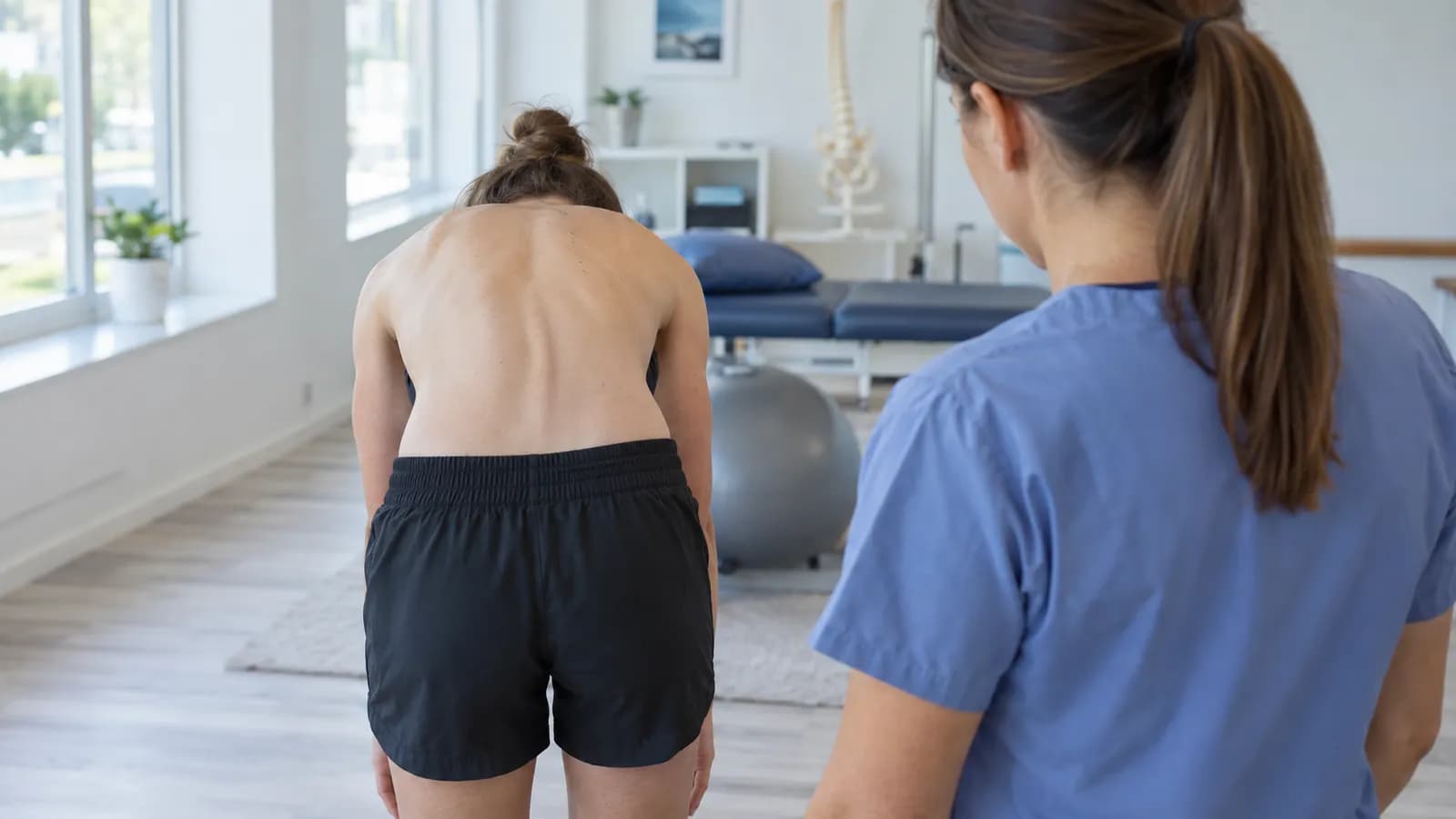
The first examination we perform in clinic has a version you can do at home: the Adams forward bend test. Have the child stand with the back bare, feet shoulder-width apart, knees unlocked. With arms hanging freely, they bend forward from the hips, fingers travelling towards the floor. Sit behind them and bring your eyes level with their back.
- Does one side rise like a ridge? That bulge — the rib hump — is the outward sign of vertebral rotation.
- Does one side of the waist look fuller than the other?
- Standing upright, are shoulder heights, shoulder blade prominence and waist crease depth equal?
- With arms hanging down, is the triangular gap between arm and trunk the same on both sides?
This is a screening tool, not a diagnosis. If you see a bulge, the next step is a standing spine X-ray and a measurement; if you do not, it is still worth looking again a year later while growth continues. Phone photos taken from the same distance and angle make a six-month comparison much easier.
What the Cobb angle tells you, and where the thresholds sit
Curve size is measured on X-ray with the Cobb angle: the angle between lines drawn along the most tilted vertebra at the top and at the bottom of the curve. The thresholds used in practice look roughly like this:
- Below 10°: scoliosis is not diagnosed. It is followed as spinal asymmetry.
- 10-25°: a diagnosis exists; the mainstay is monitoring plus exercise-based physiotherapy. If growth is ongoing, repeating the measurement is what matters.
- 25° and above in a still-growing child: bracing enters the discussion. The decision rests on the angle, the growth remaining (bone age) and how much the curve has increased over the last six months.
- Above 45-50°: surgical assessment is discussed.
These numbers are signposts, not a vending machine. The same 30° means different things in different children: rapid progression is expected in an eleven-year-old girl, while the picture is usually stable in a seventeen-year-old who has finished growing. How the thresholds apply is decided by the orthopaedic doctor examining the patient — as the physiotherapy side, we work inside that decision rather than replacing it. If you want a second reference, the UK health service's scoliosis page is a plain-language starting point.
A brace and exercise do not replace each other
We hear both sentences often, and both are wrong: "She is in a brace, so exercise is unnecessary" and "We are doing the exercises, so we can skip the brace." They are two different tools doing two different jobs.
A brace is a mechanical restraint: it aims to stop the curve progressing while growth continues, and its effect depends on the number of hours worn per day. Exercise does what a brace cannot — it builds left-right balance in the trunk muscles, keeps muscles that tend to weaken inside a brace working, directs breathing into the region the curve compresses, and develops the child's own ability to hold the trunk in alignment. That skill is what holds on to the gains once the brace comes off.
Our three-dimensional scoliosis programme is built on that logic: correction positions tailored to the direction of the curve, breathing work that accounts for rotation, and a short daily home routine. To support trunk control and the deep abdominal and back muscles, we also add clinical Pilates sessions to the plan.
The honest limits of exercise

We want to be precise here, because the internet says otherwise. Exercise does not fully correct a structural curve. There is no set of movements that takes a Cobb angle to zero, and claiming that exercise straightens a rotated spine is not a measurable claim. What exercise genuinely aims at:
- Trying to slow the rate of progression during the growth period
- Improving trunk balance and visible symmetry — shoulder and waist level, and how far the trunk shifts off centre
- Increasing flexibility and breathing capacity on the compressed side of the rib cage
- Reducing back pain and end-of-day fatigue
- Making the child's ability to notice and correct their own posture durable
None of that is a small gain. But the gap between "the curve will go away" and "the curve will be managed" is what lets a family build a realistic plan. When the programme runs as two or three clinic sessions a week plus 15-20 minutes at home daily, the result becomes measurable; without the home routine, clinic sessions alone do not carry it.
Back pain, adult scoliosis and when to see a doctor
Adolescent scoliosis is often painless, which is what surprises parents most. Pain usually enters later: either when a curve carried since youth starts loading discs and facet joints with age, or when degenerative scoliosis develops after fifty as the spine wears. In adults the goal is rarely to change the angle — it is to manage pain, build trunk endurance and protect daily function.
See a doctor without waiting if:
- You see a clear rib hump on the forward bend test
- A known curve has visibly increased within six months
- Night pain that does not settle, pain radiating into the leg, numbness, weakness or a change in bladder or bowel control appears alongside the curve
- A curve is noticed at a very young age (under five)
- There is scoliosis in the family and the child has entered a growth spurt
Not everyone with scoliosis has back pain, and when pain appears the source is usually the uneven load on surrounding muscles rather than the curve itself. the mechanical causes of low back pain are explained with everyday examples in our companion article.
At our clinic in Muratpaşa, Antalya, we carry out scoliosis assessment, read the X-ray you already have, build an exercise plan specific to the direction of your curve, and follow you through the growth period. If you have no imaging yet, we will tell you which film is needed and which specialist to see. You can book an appointment for an assessment — bring your most recent X-ray if you have one.
This article is for information only and does not replace a medical examination. Diagnosis, imaging, and bracing or surgical decisions in scoliosis are made by the doctor who examines the patient.