"The MRI shows a herniated disc. Am I going to need an operation?" Most people who come to our clinic with a slipped disc open with some version of that question. Most of the fear comes not from the pain but from the words on the report: "extrusion", "nerve root compression", "thecal sac indentation". They sound like the first step towards an operating theatre.
In reality, a large share of people diagnosed with a lumbar disc herniation recover without surgery. Below we explain what the report terms mean, what we look at in the examination, and where non-surgical treatment is enough and where it is not. Symptoms that need an emergency department the same day have their own heading.
The disc on your MRI and your pain are not always the same thing
A disc is a cushion between the vertebrae: a tough fibrous ring around a softer core. With age it loses water, the ring weakens and disc material can move backwards, towards the nerves. Reports usually grade this with four terms:
- Bulging: the disc extends slightly beyond its normal edge over a wide area. Very common with age and often causes no symptoms on its own.
- Protrusion: one part of the disc pushes out more clearly, but the base of the bulge is still broad.
- Extrusion: disc material has pushed further through the outer ring; the displaced part is wider than its connection to the disc.
- Sequestration: a fragment has separated completely from the disc and lies free in the spinal canal.
Two things matter here. First, many adults with no pain at all show bulges or protrusions on MRI, and these become more common with age. A herniation on a scan does not, by itself, prove it is causing your pain today. Second, and this surprises patients most: some of the large, frightening-sounding herniations (extrusions and sequestrations) are known to shrink by themselves over time, as the body gradually clears away disc tissue outside the disc.
That is why we plan treatment around the examination and your symptoms, not around the image. Someone whose report says "large herniation" but who walks comfortably with a clear examination is on a very different path from someone with a mild-looking scan and a weakening foot.
First, the emergency: symptoms that need hospital the same day
In a small number of cases, a disc herniation presses on the bundle of nerves at the lower end of the spinal canal, the cauda equina. This is not something to wait for a physiotherapy appointment with; hours matter. If any of the following is new, go to a hospital emergency department the same day (in Turkey this is the "acil servis"), without waiting for an appointment:
- Difficulty starting to pass urine, being unable to hold urine, or not feeling that your bladder is full
- A new change in bowel control
- Numbness or reduced feeling in the groin, around the genitals and anus and on the inner buttocks, the area that would touch a bicycle saddle (saddle numbness)
- Weakness in both legs, or pain and numbness spreading into both legs at once
- A sudden, unexplained change in sexual function
These can start mildly, and people are sometimes embarrassed to mention them. We ask every disc patient directly, but please tell us without waiting to be asked.

Back pain or nerve pain running down the leg?
A disc herniation can cause two different kinds of pain, and telling them apart changes the treatment. The first is a deep, dull ache in the back itself that worsens with bending or long sitting. It has many possible causes besides a disc; we cover muscle, joint and posture causes in our article on lower back pain causes and everyday care.
The second comes from an irritated nerve root: burning or electric pain from the buttock to below the knee, sometimes to the toes. The leg often hurts more than the back, coughing can make it flare, and tingling or numbness may follow. This is usually called sciatica; we explain when to take it seriously in our article on sciatica and pain shooting down the leg.
With back pain alone, a herniation on MRI may well be incidental. Leg pain following a specific nerve suggests the disc really is touching it, and then we track the nerve, not the size of the herniation.
What we test in the examination
An MRI is a photograph; the examination shows how your back and nerves work today.
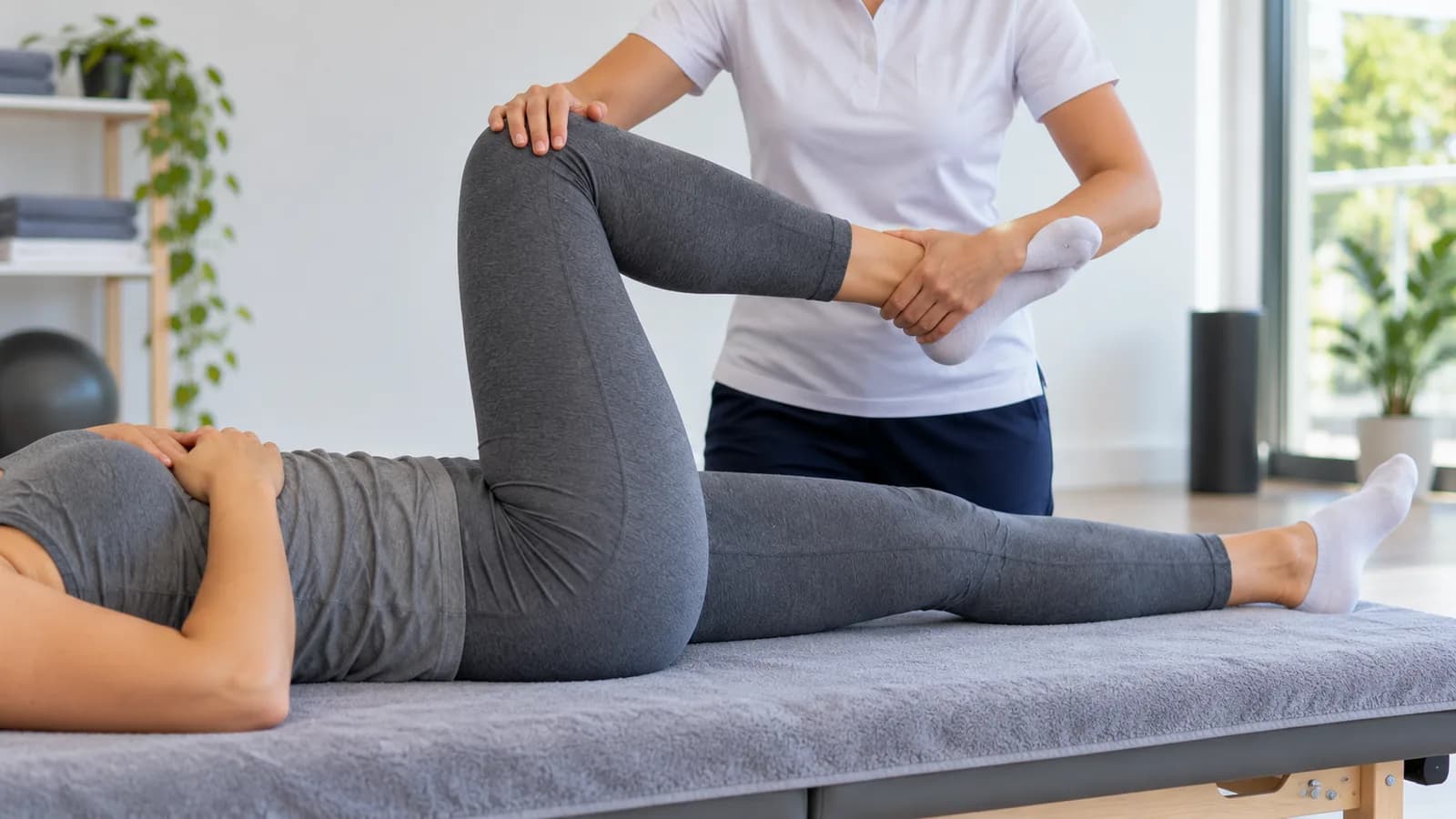
Straight leg raise: lying on your back, we lift your straight leg slowly. If your familiar leg pain appears at a certain angle, the nerve root is irritated. Repeating the test over the weeks gives a concrete measure of progress.
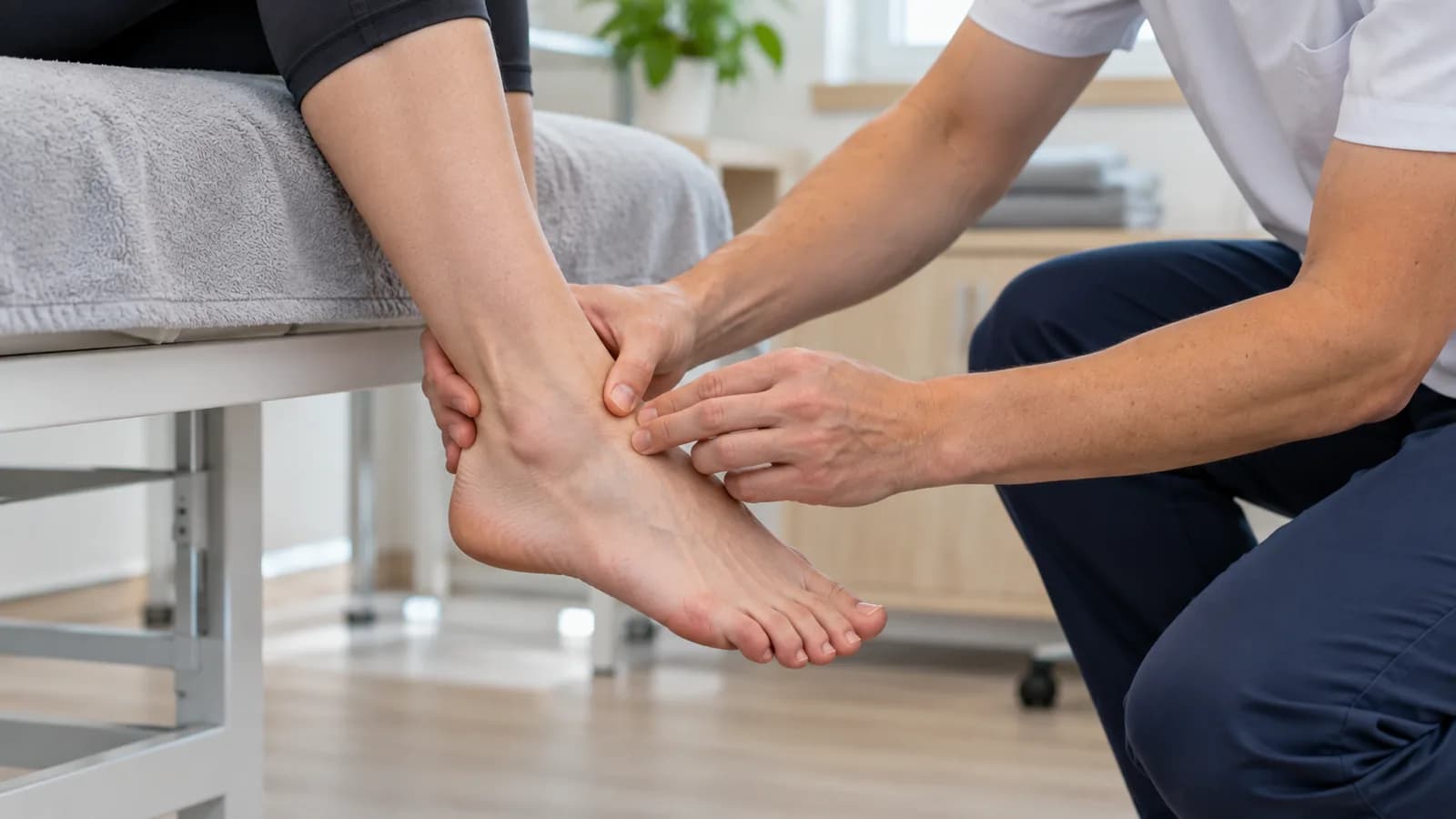
Reflexes, strength and sensation: knee and ankle reflexes, lifting the ankle and big toe, rising onto tiptoe and skin sensation show which nerve root is involved and how much. Any weakness is recorded and re-measured every session, because it changes the plan more than anything else.
Centralisation: we move your back repeatedly in certain directions and watch the pain. If leg pain retreats towards the back, that is centralisation, usually a good sign that sets the direction of the exercises. A movement that pushes pain further down the leg is reduced for now.
Everyday tolerance: how long can you sit or walk, how do you put your socks on, does pain wake you at night? Simple questions, but the most honest measure of whether treatment works.
What non-surgical treatment involves, and what we do not promise
Weeks of bed rest used to be standard advice. We now know it does not speed recovery and costs strength and confidence. Short rest breaks are fine when pain is severe early on, but the aim is to keep moving as much as you can tolerate: short walks, frequent changes of position, and daily tasks that do not clearly make the pain worse.
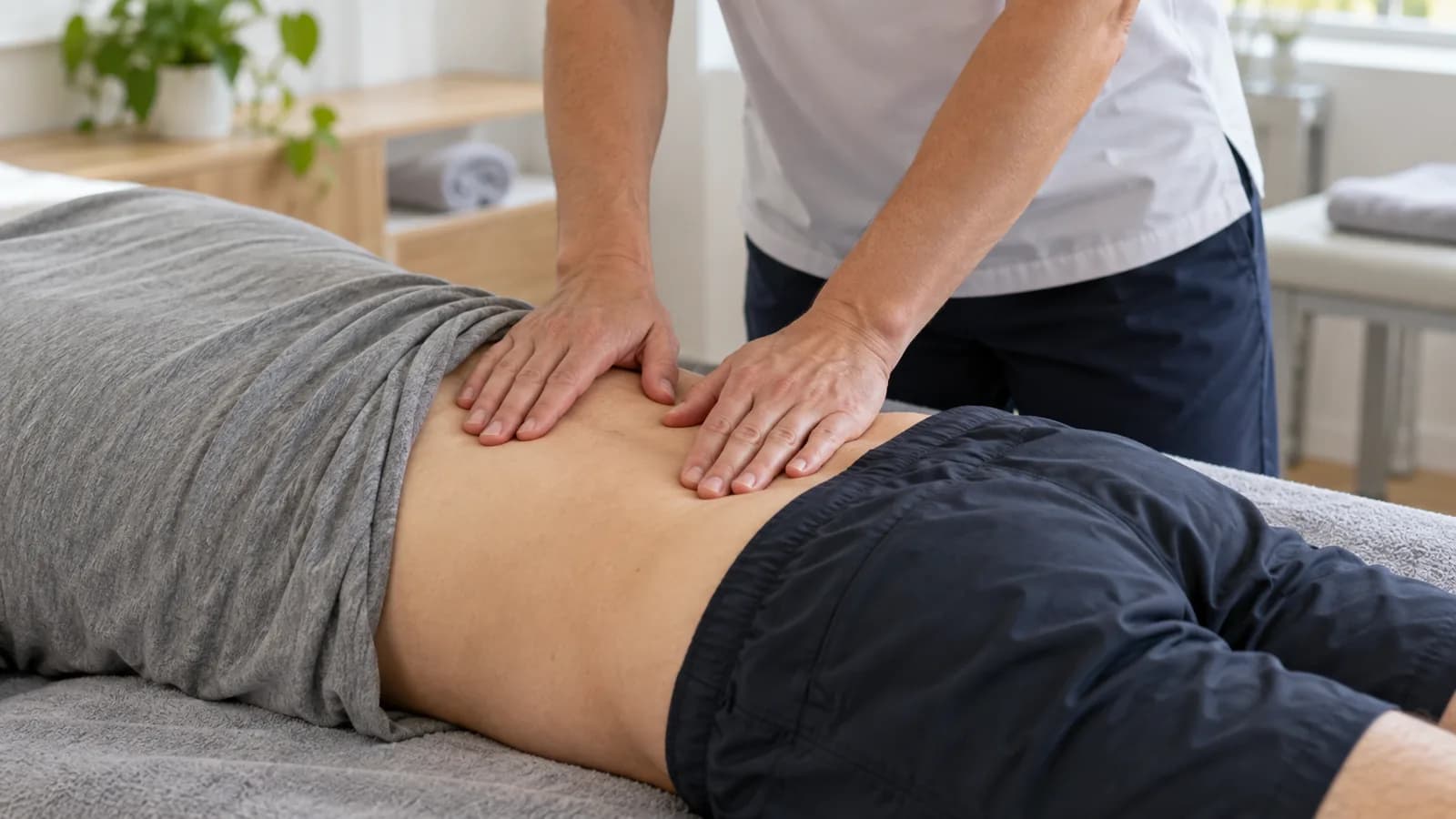
First we give the movements that centralised your pain, as short sets through the day. As the pain retreats from the leg towards the back, we increase the load step by step: first in supported positions, then standing, and finally in the bending and lifting your work actually requires. Trunk stabilisation, teaching the abdominal, back and hip muscles to work together to carry your spine, is the backbone of this process. We use manual therapy as a tool to improve joint mobility, ease muscle spasm and make the step into exercise easier, not as a treatment on its own.
The last part of the programme is a return-to-work plan. We talk through which movements your job demands, how often and with what load, and we order the exercises around them.
We should be honest about one thing: physiotherapy does not shrink every herniation, and we do not promise that it will. Some herniations shrink by themselves over time; others look the same on the MRI while the person lives without pain. Our goal is not to change the picture but to calm the irritated nerve and get you back to your daily life.
A herniation that is still visible on a follow-up MRI does not mean treatment has failed. What we measure is not the size of the disc, but how far you can walk, how long you can sit and whether the strength in your leg is coming back.
Back to work in Antalya: making beds, bending in greenhouses, hours behind the wheel
In Antalya, our patients' jobs shape much of the programme. Hotel housekeeping staff make many beds a shift, and tucking sheets with a bent, twisted back is one of the positions a disc tolerates worst. With them we practise kneeling on one knee against the edge of the bed, bending from the hips rather than the lower back, and splitting the job between both sides of the bed. Where possible, we plan a gradual return rather than full shifts from day one.
For greenhouse workers around Kumluca, Demre and Serik, the issue is less heavy lifting than staying bent for hours along low rows. Banning bending is not realistic, so we build in short breaks to straighten up and practise half-kneeling.
Transfer drivers shuttle between the airport and Kemer, Belek and Side several times a day; long sitting often aggravates disc-related leg pain, and then come the suitcases. Airport baggage handlers show a similar pattern: repeated lifting in tight spaces with a twisting trunk. If you have flown in for a holiday with a sore back, the long flight itself is a familiar trigger. With these patients we work on breaking up sitting with short pauses, keeping loads close to the body and turning with the feet rather than the spine.

When does surgery come into the picture?
The decision to operate is not made by a physiotherapist; it belongs to a neurosurgeon or orthopaedic spine surgeon. Our job is to recognise early the picture that calls for that decision and refer you in time.
The first is progressive weakness, such as being unable to lift the ankle or the toes catching the ground (foot drop). If weakness worsens between sessions, we refer you to a doctor without continuing. The second is unbearable leg pain that does not ease over weeks, despite medication, positioning and exercise. The third is nerve pain that keeps limiting daily life despite an adequate period of properly delivered conservative treatment. Cauda equina symptoms sit outside this list altogether; they are an emergency.
Patients who have surgery often come back to us afterwards: surgery removes pressure on the nerve, but restoring strength and sitting and lifting tolerance is the job of rehabilitation.
In short, a diagnosis of a herniated disc does not mean you will need an operation, but some symptoms should not be waited out. For neutral background reading, the NHS page on slipped discs is a good place to start. If pain or numbness running down your leg has lasted more than two weeks, or the time you can sit and walk keeps getting shorter, you are welcome to come to our clinic for an examination. Bring your MRI report with you and we will read it together.