"My hip hurts." We hear it in the treatment room all the time. Then we ask the patient to show us where, and the picture changes. One presses their fingers into the groin. Another lays a palm over the bony point on the outside of the hip. A third reaches behind, to the buttock and the bottom of the lower back. Same word, possibly three different structures.
In everyday language "hip" covers a large area. The joint itself, where the ball of the thigh bone sits in the pelvic socket, lies deep behind the groin. Outer-side pain usually comes from the tendons attached there, not the joint. Pain at the back is often not from the hip at all but referred from the lower back or the pelvis. Below is the simple map we use in our clinic: the location of the pain tells us where to start. It does not make the diagnosis, but it prompts the right questions.
Before we begin the examination we ask the patient to point to the pain with one finger. Where that finger lands decides the order of every test that follows. A rough map looks like this:
- Front of the hip and deep in the groin: this points first to the hip joint itself (osteoarthritis, impingement, labral problems).
- The outer side, over the bony point: usually the tendons of the side hip muscles and the small fluid sac around them.
- The back, the buttock and just below the waistline: often pain referred from the lower back, or the sacroiliac joint.
The map is not absolute: hip joint pain can travel to the knee, back pain can refer into the groin, and one person can have more than one source. But it splits a single vague label, "hip pain", into three separate paths and saves weeks spent treating the wrong place.
Front of the hip: usually the joint itself
When the pain sits deep in the groin and sometimes spreads down the front of the thigh, we think first of the joint. Patients describe it through movement: "Putting my socks on is a struggle", "When I swing my leg out of the car, something catches in my groin", "Tying my shoes has become hard."
From middle age onwards the most common cause is hip osteoarthritis. There is stiffness on getting up in the morning that eases fairly quickly, and pain that builds after a long walk. Over time the hip loses its ability to turn inwards, and people start to limp slightly without noticing.
In younger, active people the picture is different. In femoroacetabular impingement the ball and socket make contact too early at certain angles, so deep squats, sitting for long periods in low seats or certain sports bring on sharp groin pain. A tear of the labrum, the rim of cartilage around the socket, can cause similar complaints, sometimes with a catching or locking sensation.
To be honest: labral tears and impingement-type bone shapes show up on scans in many people with no pain at all. An MRI finding is not, on its own, the cause of your pain; it has to be read together with the examination.
The outer side: tendons, and "I can't lie on that side"
The bony point you can feel on the outer side of your hip is called the greater trochanter. Pain here was long called "trochanteric bursitis". We now know it is usually not an inflamed fluid sac but a load problem in the gluteal tendons, so it is now usually called greater trochanteric pain syndrome, or gluteal tendinopathy.
The typical complaints are very recognisable. Lying on that side wakes you at night, and turning over hurts. The outer hip aches more on stairs and hills. Crossing your legs, or standing with your weight on one leg and the hip "hanging" out to the side, brings on the pain. The first steps after sitting for a while feel sharp.
This problem is most common after the age of forty, and especially in women around the menopause. We say this plainly because many patients assume they did something wrong. Hormonal changes are thought to affect tendon tissue; add weight change, a spell of inactivity or a sudden jump in walking, and the tendon carries more than it can handle. It is nobody's fault, and in most cases it is manageable.

The back and the buttock: often the spine is talking
When a patient puts their hand on the buttock, the lower back or around the sitting bone, our first job is to examine the back, because a good share of pain here comes from the lumbar spine. The mechanical problems we described in our article on lower back pain can easily present as "hip pain". Pain shooting below the knee with numbness suggests nerve root involvement, covered in our article on sciatica.
The second common source is the sacroiliac joint, where the pelvis joins the base of the spine at the back. It can become painful during pregnancy and after childbirth, after a fall, or with repeated one-sided loading.
Piriformis syndrome deserves a mention too. This small muscle deep in the buttock can genuinely irritate the sciatic nerve, but it is diagnosed far more often, online and in some clinics, than it actually occurs. Before calling buttock pain "piriformis", the back and sacroiliac joint must be ruled out; otherwise the wrong muscle gets stretched for weeks while the real problem stays put.
With hip pain, half of the diagnosis lies in where the patient puts their hand; the other half comes from what the movements tell us in the examination.
What we look at in the examination
The map gives direction; the examination confirms it. We generally follow this order.
Range of movement: bending, opening out and, above all, turning the hip inwards. Internal rotation that is clearly reduced and painful compared with the other side is one of the most useful signs pointing to the joint itself.
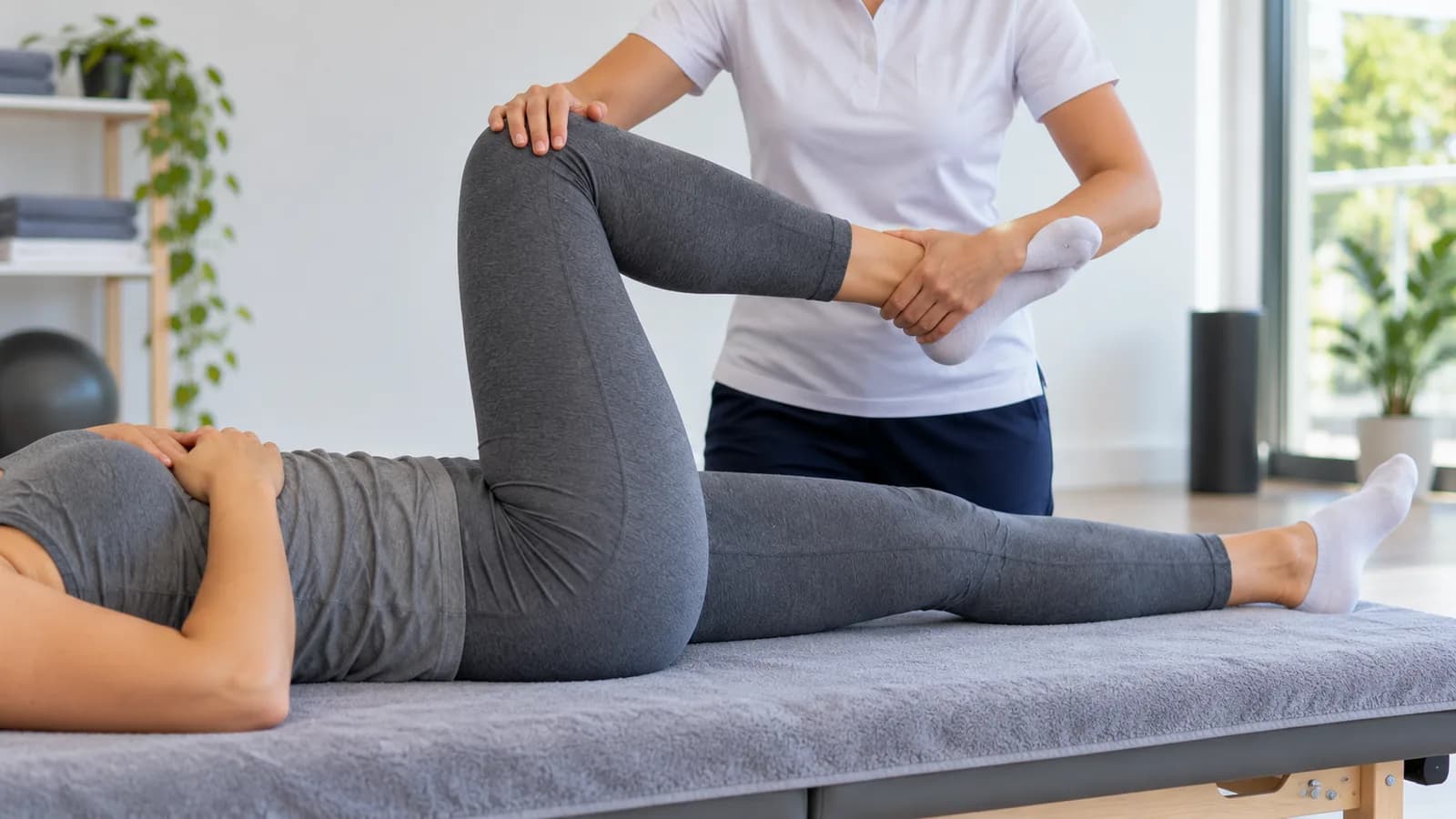
Provocation tests: lying on the back, we bend the hip, bring it across and turn it inwards (FADIR). If this reproduces the familiar groin pain, we think of the joint and labrum. In the FABER test the leg rests in a "figure four" position; whether it provokes pain in the groin or at the back steers us towards the hip or the sacroiliac joint.
Strength and balance: we compare the strength of the hip abductors, the muscles that lift the leg sideways, on both sides. Then we watch the patient stand on one leg and walk. If the pelvis drops on the opposite side or the trunk leans over, the side muscles are not coping with the load. Outer hip pain appearing during single-leg standing supports tendinopathy.
Back screen: every hip examination includes moving the lower back, and where needed nerve tension tests and reflexes.
No single test makes the diagnosis; together, and matched with the patient's story, they do. Where needed we refer to a doctor for an X-ray or further imaging.
Treatment: managing load, building strength, changing habits
The backbone of treatment for hip pain is usually the same: reduce the load that aggravates the pain sensibly, and gradually increase the capacity of the tissue. The details depend on the map.
For outer hip pain, we first reduce the positions that compress the tendon: no crossing the legs, standing with weight evenly on both feet, a pillow between the knees when lying on your side. Strengthening starts with isometric exercises, where the muscle works but the joint stays still, which painful tendons tolerate well; then we build the load step by step. A steroid injection can bring short-term relief, but research suggests that education and exercise give more lasting results in the long run.
For front-of-hip pain, and particularly with osteoarthritis, exercise comes before medication. Strengthening the muscles around the hip and keeping it moving is the foundation of pain relief. It is the same logic we explain in our article on knee osteoarthritis and exercise. Resting the joint to "protect" it usually makes things worse.
In both groups we use manual therapy alongside exercise: joint mobilisation and soft tissue techniques help free up movement and bring pain down to a level where exercise becomes possible. On its own it is not enough; lasting change comes from getting stronger.
There is an honest limit, too. In advanced hip osteoarthritis, when pain disturbs sleep, walking distance has shrunk markedly and daily life remains seriously limited despite regular exercise, an orthopaedic assessment and a hip replacement may be the right next step. That is not a failure; it is a decision made at the right time. Recovery after a replacement is physiotherapy territory as well, which we describe in our article on rehabilitation after surgery.
Everyday loads on the hip in Antalya
Hips here are tested by local habits. A common one is long walks on soft sand at Konyaalti or Lara beach. Sand makes the side hip muscles work harder with every step, so for someone with outer hip pain it is much more demanding than a firm surface. Walking on wet, packed sand or on the seafront promenade is a better place to start.
Older apartment buildings without lifts are another load. Climbing four or five floors several times a day can noticeably increase pain in both tendinopathy and osteoarthritis. In tourism, shifts spent standing all day (reception, housekeeping, hotel kitchens) invite the habit of resting on one hip, a classic posture that compresses the outer tendons.
Long drives matter too. For airport transfer drivers, and for anyone who regularly drives the road to Alanya or Kas, hours in a low seat can provoke groin pain, and getting out of the car can trigger both groin and back pain.

When to see a doctor without waiting
Most hip pain is mechanical and can be managed with physiotherapy. The following situations, however, are not a reason to book a physiotherapy appointment. They need a doctor or the emergency department straight away:
- Being unable to put weight on the leg after a fall, especially if the leg looks shorter and turned outwards. In older people this suggests a hip fracture and is an emergency.
- Severe joint pain with a fever, and being unable to move the leg
- Pain at night that does not ease with rest or a change of position
- Pain together with unexplained weight loss
- A limp, or hip or knee pain, in a child without a clear reason
- Groin pain starting after long-term use of steroid (cortisone) medication, which raises the suspicion of avascular necrosis, a loss of blood supply to the bone
For a neutral overview of the causes of hip pain, the NHS page on hip pain is a good starting point.
If the pain has lasted more than two weeks, keeps you from lying on that side at night, or has started to make simple things like putting on socks or climbing stairs harder, you are welcome to come to our clinic for an examination. We will draw the map together first, and then build a plan that suits you.