Most people with this problem open with the same sentence: I wake at four in the morning with a numb hand, I sit on the edge of the bed and shake it, and after a couple of minutes it settles. That is the classic story of carpal tunnel syndrome. At night rather than by day, in certain fingers rather than the whole hand, easing when the hand is shaken out.
Then there is a second group. The numbness has lasted a year, the muscle pad at the base of the thumb looks thinner than on the other hand, jar lids have become impossible. Two stages of the same condition, treated differently. This article is about telling them apart.
What actually happens inside the wrist
On the palm side of the wrist there is a short passage, bounded by the carpal bones underneath and a tough band across the top, the transverse carpal ligament. Nine flexor tendons and the median nerve travel through it together. Its walls are bone and stiff ligament, so the tunnel cannot widen.
When the volume inside increases, through swelling of the tendon sheaths, fluid retention or a deformity after a fracture, pressure rises and the nerve feels it first. Under pressure the median nerve slows its conduction: numbness and tingling, and if it lasts, permanent damage. A wrist held fully bent multiplies that pressure, and nobody controls how far the wrist folds during sleep. That is largely why symptoms come at night. For a neutral overview, the NHS page on carpal tunnel syndrome is short and reliable.
Check your little finger: the most useful clue is in your own hand
The median nerve carries sensation from the thumb, the index finger, the middle finger and the thumb-side half of the ring finger. The little finger is outside that territory; its sensation comes from the ulnar nerve, which does not pass through the carpal tunnel.
So if your little finger is numb too, the problem is probably not inside your wrist.
Two more details carry weight. Timing: numbness that picks the night, and turns up while holding a steering wheel or a phone. And relief from shaking the hand out, called the flick sign.
As it progresses the picture shifts from sensation to strength. Jar lids will not turn, keys become awkward, glasses slip out of the hand. The finding noticed last is wasting of the thenar pad at the base of the thumb, usually spotted with both hands side by side. That is no longer numbness but loss of the muscle the nerve supplies.
Not every numb hand is carpal tunnel
This is the misunderstanding I correct most often. Numb hands have at least four other addresses:
- Nerve root compression in the neck (cervical radiculopathy): numbness runs from the neck down the arm, turning the head changes it, pain between the shoulder blades often comes with it.
- Thoracic outlet syndrome: heaviness through the whole arm when it is raised or after carrying a bag.
- Ulnar nerve entrapment at the elbow: the little finger and the outer half of the ring finger, worse with the elbow bent.
- Polyneuropathy: a glove-and-stocking pattern in both hands and usually both feet, with diabetes, B12 deficiency or thyroid disease.
They can also combine: with a mildly irritated nerve root in the neck, compression at the wrist produces symptoms more easily. So we examine the neck and shoulder girdle too, not the wrist alone.
Who gets it, and how true is the keyboard story
This is not a condition with a single cause. Behind the cases we see there is usually one of these:
- Pregnancy: driven by fluid retention, noticeable in the last trimester, and in most women settling within weeks of delivery.
- Hypothyroidism, diabetes, rheumatoid arthritis and obesity.
- The months after a wrist fracture, dislocation or severe sprain.
- Repetitive work that keeps the wrist bent with a firm grip.
- Vibrating hand tools: breakers, grinders, powered pruning shears.
In Antalya the list translates concretely: greenhouse pruning and picking, knives and trays in a restaurant kitchen, vibrating tools on building sites, scissors in a tailor's shop.
The keyboard question deserves an honest answer. I got carpal tunnel from working on a computer rests on weaker ground than people assume: keyboard and mouse use alone has not been shown to raise the risk substantially. Forceful gripping, vibration and a wrist held bent for hours do. When an office worker has symptoms, the culprit is usually the angle of the wrist on the desk and the hours without a break.
What we measure in the clinic
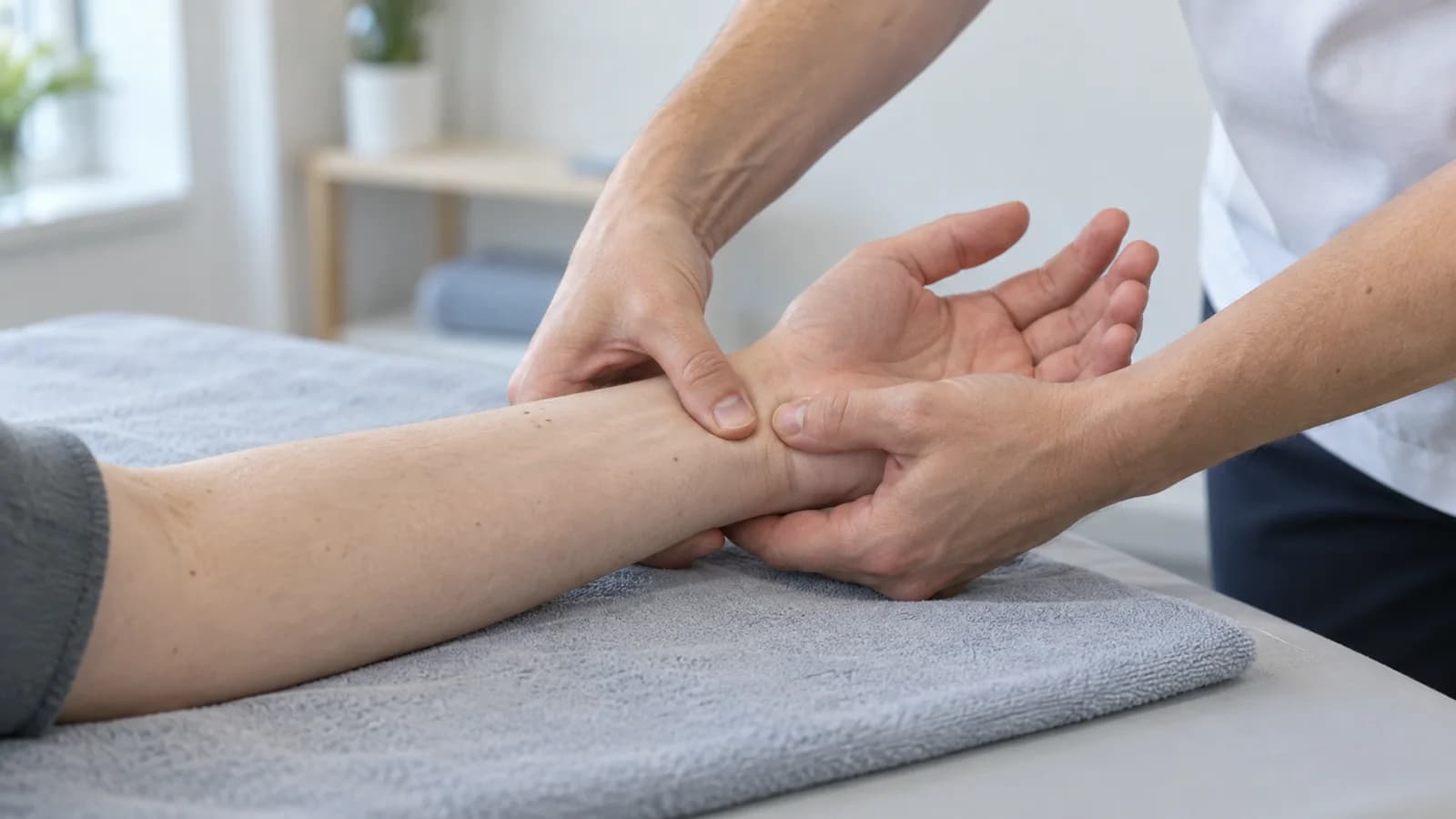
We start with the story, then test by hand. In the Phalen test the wrist is held bent for a minute to see whether numbness appears; in the Tinel test we tap over the palm side of the wrist, and tingling that shoots into the fingers is meaningful. We add sensory testing, grip and pinch strength, a comparison of thenar bulk, and a neck and shoulder examination.
On their own, the Phalen and Tinel tests neither confirm nor rule out carpal tunnel. We see clear compression in patients whose tests are negative, and a different cause in patients whose tests are positive. Read alongside the history they are useful; read alone, they mislead.
For a definitive diagnosis and, more importantly, for severity, nerve conduction studies and EMG are needed, ordered by a doctor. Is the compression really in the median nerve, and how badly is it affected? The second answer changes treatment directly, so we never debate the test in a patient who has lost strength.
The treatment ladder, and the honest limit of physiotherapy
In mild and moderate cases the first step is a night splint that keeps the wrist neutral and prevents the pressure rise during sleep. It has the best evidence behind it of any simple measure here, on two conditions: the splint must genuinely hold the wrist neutral, since off-the-shelf ones that push it backwards do not help, and it must be worn every night for four to six weeks. I wore it now and then is not a result.
The second step is reducing the load: breaking up forceful gripping, giving repetitive work a rhythm, changing the tool. The third is nerve and tendon gliding exercises, which let the nerve slide more freely inside the tunnel: two or three times a day, few repetitions. An exercise that increases numbness or pain is not being done correctly.
We add manual therapy for the forearm, the graston technique where indicated, correction of the neck and shoulder girdle, and splint training. A corticosteroid injection is a step a doctor may choose; the benefit is real but usually temporary.
Now the limit. If numbness has become constant, the muscle at the base of the thumb has wasted, weakness is progressing, or the nerve study shows severe involvement, then surgery, a carpal tunnel release, is more effective than physiotherapy. Months of conservative treatment for a hand like that carries a real risk of permanent nerve damage.
Physiotherapy is a strong option here, but not at every stage. In an advanced case our job is not to keep the patient busy for three months; it is to send them for a surgical opinion and rebuild the hand afterwards.
What actually helps at home:
- Do not sleep with the wrist folded; even without a splint, changing how the arm rests on the pillow makes a difference.
- Keep the wrist neutral when you grip a phone, a glass or a tool; force from the arm, not the fingertips.
- In repetitive work, a one to two minute break every 40 to 45 minutes: open the hand, straighten the fingers, let the wrist go loose.
- Heat and cold may quiet the symptom briefly, but do not change the pressure inside the tunnel.

Do not wait with these symptoms
These are not situations for let us watch a little longer. They need a doctor:
- Numbness that no longer goes away, unrelieved by shaking the hand.
- Thinning of the muscle pad at the base of the thumb, a visible difference between the hands.
- Progressive weakness: dropping things, trouble with jars and keys.
- Numbness starting immediately after a wrist fracture, dislocation or heavy blow.
- Widespread numbness in both hands, with unsteadiness, numb feet or changes in speech or vision.
In pregnancy we are more patient, because it usually settles after delivery. But lost strength is never a reason to wait.
In Antalya you still have to use your hand
Most people who come to us cannot stop working; the greenhouse, the kitchen, the workshop and the till carry on. So our job is not only to hand over exercises but to work out which movements load the wrist most, and how to do the same task with less strain. At our clinic in Muratpasa we combine manual therapy, the graston technique where indicated and splint training.
If the numbness changes when you turn your head, or pain between the shoulder blades comes with it, the article where we explain how posture and neck pain are linked may be closer to your situation. If you want to know what our hands-on techniques involve, the article on how manual therapy works is a good place to start.
If numbness in your hand has lasted more than two weeks, come in for an assessment. We will either start manual treatment and exercises, or tell you plainly that the right address is a surgical opinion.