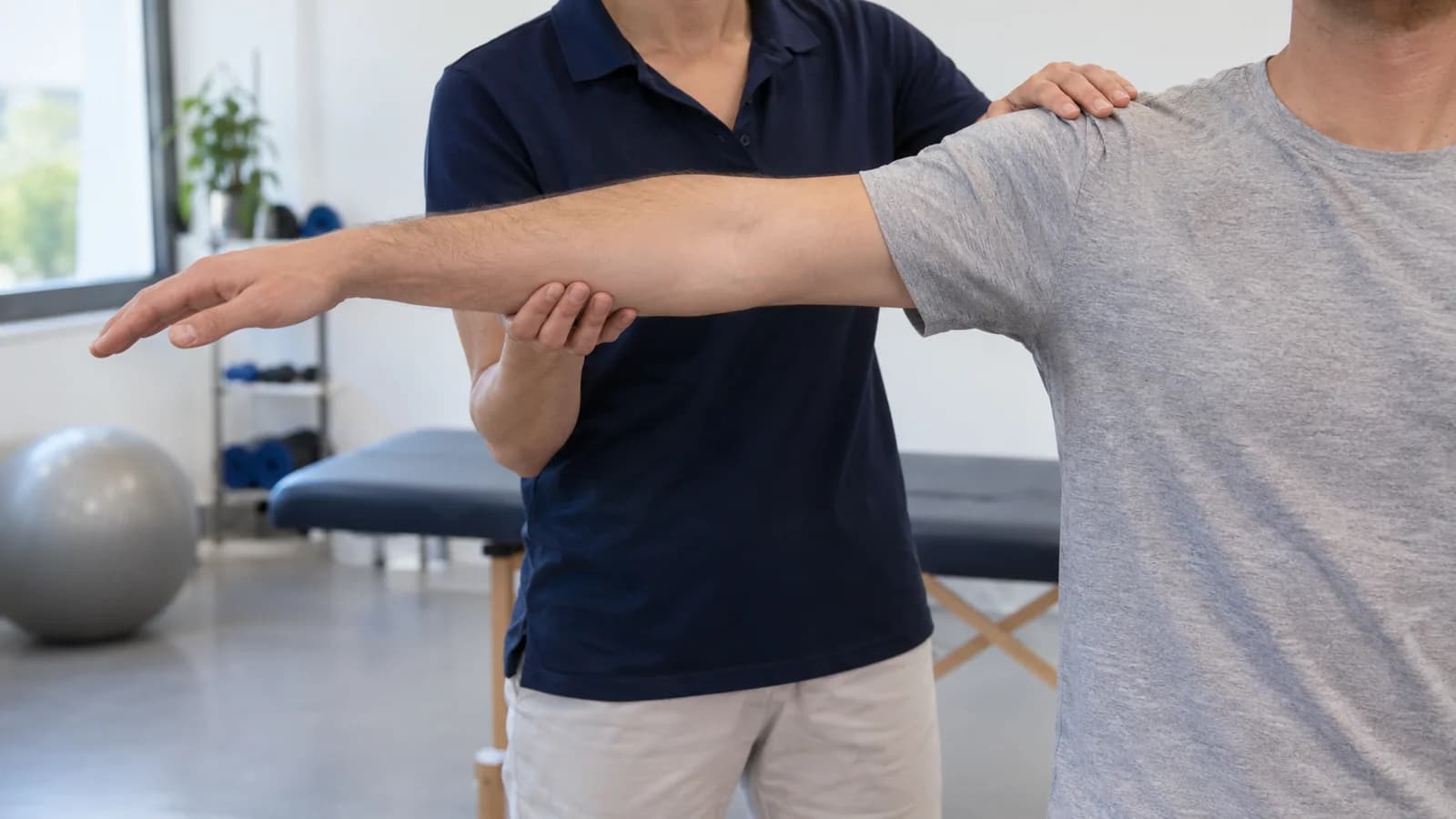
Most people who come in with shoulder pain show me the movement before they describe it. The arm goes out to the side, stops at a certain height, the face tightens, the arm comes down: "right there." Then the second sentence, almost every time: "And I can't sleep on that side." Those two tell us a great deal before we touch the shoulder.
There is usually an MRI report in the bag too: tendinitis, impingement, sometimes tear — and that one word has kept people from using their arm for months. Most shoulder pain comes from the rotator cuff and most of it does not need surgery. Some of it does belong to a doctor, and I will explain how we tell the difference.
The rotator cuff: four muscles holding the ball in the socket
The shoulder is the most mobile joint in the body and it pays for that freedom. There is no deep socket as in the hip; the head of the arm bone rests against a shallow dish on the shoulder blade, like a golf ball on a tee. Stability comes from muscle, not bone — the design that lets you scratch your own back is the design that gets you into trouble.
The rotator cuff is the name of the four muscles doing that job. They wrap the head of the bone like a sleeve and keep it centred:
- Supraspinatus — starts the lift of the arm sideways. This is the tendon that usually hurts.
- Infraspinatus — rotates the arm outwards, as when you reach for a bag on the back seat.
- Teres minor — the smaller partner of the infraspinatus, supporting the joint behind.
- Subscapularis — rotates the arm inwards, stopping the ball drifting forwards.
When the timing between these four slips, the ball rides upwards as you lift. Above it sits a bony roof, the acromion. As the gap narrows, the supraspinatus tendon and the bursa above it are squeezed with every repetition. So the problem is usually less about weak muscles than about muscles firing in the wrong order.
The pattern we see most: subacromial impingement
The story is so consistent we can often predict the examination from it. Pain appears while lifting the arm sideways between 60 and 120 degrees — the painful arc. The start of the lift is fine, the middle hurts, near the top it eases again. Anything overhead multiplies it. Reaching behind the back gets awkward — the back pocket, the bra strap. And the complaint people mention most: a deep ache the moment they lie on that side, the kind that wakes you at three in the morning.
It creeps in. Nobody can name the day it started.
The most misleading sentence in shoulder pain is "but I didn't do anything." A tendon does not remember yesterday; it remembers the last two months.
In Antalya the crowd is predictable: hotel and service staff working above shoulder height, painters and plasterers, warehouse workers loading high shelves. Swimmers at the start of the season — nothing all winter, then three sessions a week in July. Tennis, volleyball, diving. And the largest group: people hunched at a desk for six days who paint a wall on the seventh.

Frozen shoulder or rotator cuff? The examination decides
To the person in pain these feel identical: the shoulder hurts, the arm will not go up. To us they are very different, and the test is simple — we check passive movement.
With a cuff problem, lifting the arm with your own muscles hurts — but when I lift it for you, the range is there. The muscle is not contracting, so the tendon is not loaded: pain, yes, but movement too. In frozen shoulder, adhesive capsulitis, the capsule itself has tightened, so the arm stops at a certain point even when I lift it, as if made of wood. The telling sign is loss of external rotation: elbow tucked to the body, the forearm will not swing outwards.
Frozen shoulder starts more insidiously, is linked with diabetes and thyroid problems, moves through freezing, frozen and thawing stages, and takes months. Somebody who stops using the arm for months because of cuff pain is inviting one, and the two can overlap. Reducing the dose of movement is one thing, stopping it is another.
Your MRI says "tear" — read this before panicking
Over the age of forty, degenerative change in the cuff is extremely common. How do we know? Because when volunteers with no shoulder pain are scanned, tendinosis and partial tears turn up in them too, and the proportion climbs with age. Among people in their sixties with comfortable shoulders, a sizeable share have something visible on the cuff.
So "tear" in a report is very often an age marker like grey hair — not a diagnosis on its own, and not a reason for surgery. Size does not track severity: some large tears are silent, some small tendinosis cases keep people awake. What decides is the history, the examination, whether strength is genuinely lost, and how long the complaint has resisted a proper programme.
One group stays separate: the traumatic full-thickness tear. After a clear event — a fall, the arm yanked — strength drops suddenly and the person says, "I try to lift it and the arm drops." That needs an orthopaedic opinion, and in a younger patient surgery comes onto the table early. When we hear that story we do not write a programme, we refer.
When to see a doctor rather than a physiotherapist
Most shoulder pain is benign, but the shoulder is also a place where other organs send their pain. If any of the following is true, see a doctor before booking physiotherapy:
- Inability to lift the arm after a fall or a sudden pull, with clear loss of strength
- Visible deformity, a sense the joint has come out, or the arm held oddly
- Fever with redness, swelling and heat over the shoulder
- Pain that does not settle at rest, with unexplained weight loss or night sweats
- Left shoulder pain with chest pain, breathlessness, cold sweat or discomfort spreading to the jaw — possibly a cardiac emergency, call 112
- Numbness, tingling or weakness spreading into the hand — the source may be the neck
A plain summary of these warning signs is on the NHS shoulder pain page, worth reading before hunting for worst-case explanations.
What the evidence says about exercise, injections and surgery
The finding that surprises patients most: in subacromial pain, a graded loading programme produces results as good as decompression surgery. Large trials with a real surgery arm and a sham surgery arm found no advantage for the operation over exercise. Surgery is not never needed — traumatic tears and stubborn cases exist — but the first step is not a scalpel.
A cortisone injection, honestly: in the short term it does reduce pain and restore sleep. By three months the injected and non-injected groups converge. It is not a lasting solution alone, and repeating it wears the tendon. An injection is the door into a programme, not a substitute for one. And the programme itself asks for six to twelve weeks of patience: in the first fortnight most people feel no clear difference, which is normal. Whoever quits in week three says "it didn't work" when they had only just begun.
What we do in the clinic, and what you can do at home
We do not start with cuff strengthening. We start at the shoulder blade: if the scapula does not rotate at the right moment, no amount of band work stops that gap narrowing. A stiff thoracic spine does the same. Then the capsule at the back of the joint, then graded cuff loading: isometric holds, elastic band, weight, finally the real movement of your job or sport. Progression follows the strength we measure, not the pain of the day. Manual therapy, Graston technique and clinical Pilates are tools inside that programme, not treatments on their own.
Three rules for home. Loading: pain should stay around four or five out of ten during exercise and not spill into the next day; worse in the morning means one step back, not stop. Overhead activity: cutting it out completely often harms, so reorganise instead — what you use often goes below shoulder height, stand on a step for high jobs, carry weight close to the body. And the night: do not lie on the painful side, put a thin pillow under the arm on your back, and if you sleep sideways keep the good shoulder down with the painful arm on a pillow in front of you. Sleeping through the night is usually the first thing a programme gives back.

If your shoulder has been hurting for months
Waiting three months for shoulder pain to go away by itself is the most common mistake we see. The tendon does not quietly repair in that time; you stop using the arm, and the lost movement adds new problems to the old one. Pain lasting two or three weeks that disturbs your sleep deserves an examination.
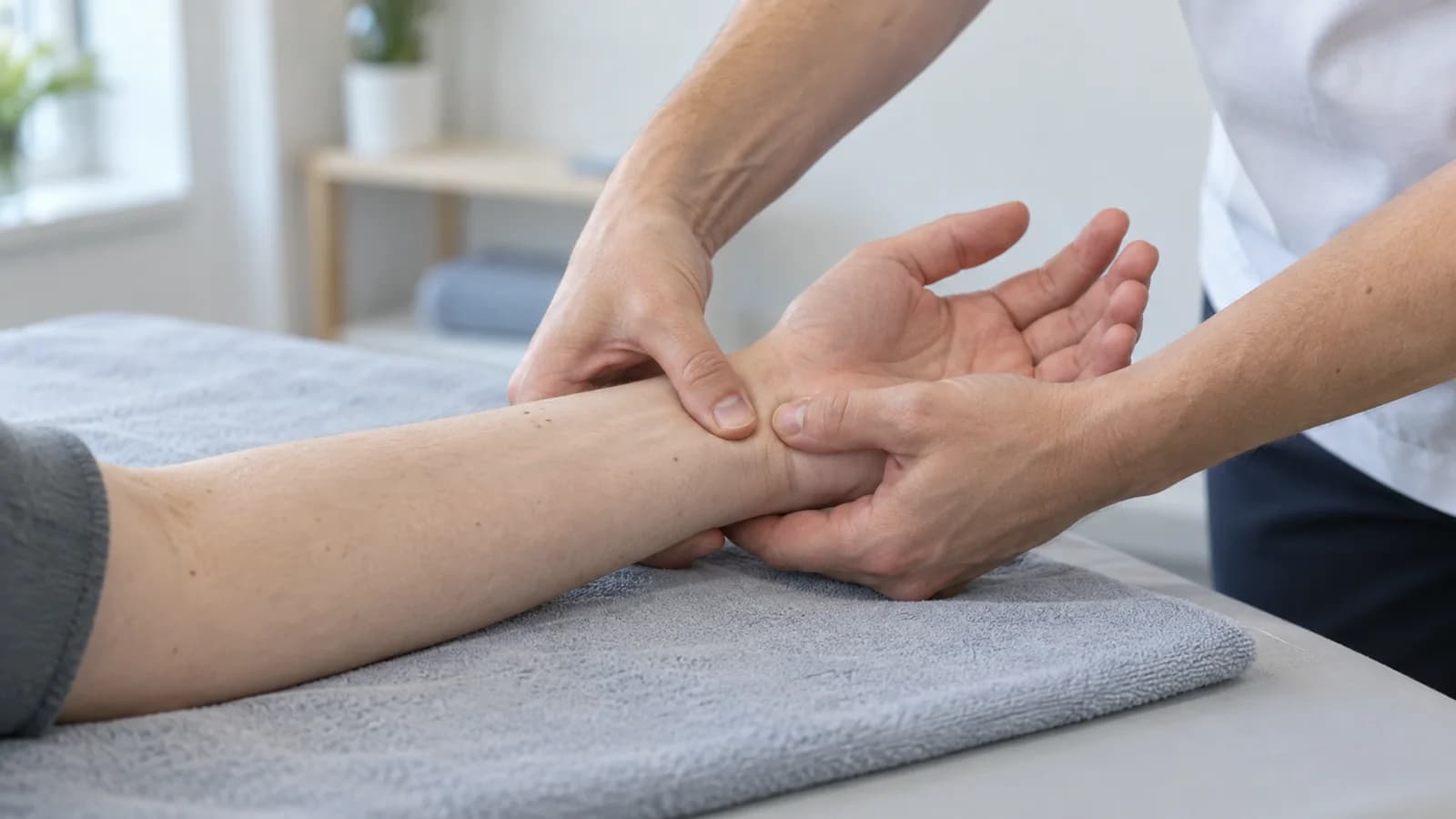
At our clinic in Muratpaşa the assessment begins with the painful arc and a comparison of active and passive movement. If the range is missing even when I lift your arm, read our article on the stages of frozen shoulder; if you wonder what the hands-on work actually changes, see what we wrote about where manual therapy is used. We see international patients regularly; consultations can be held in English. — Serdar Mataracı, PT