Most people reading this are not the patient. You are the spouse, the son or daughter, the person who organises the day. The question usually starts in the same place: my father has just had a hip replacement and cannot manage the stairs; my mother had a stroke and getting her to a clinic and back takes half a day. Below we set out who home physiotherapy suits, what we actually do in the first visit, what can and cannot be done in a flat, and the part of the work that will fall to you.
Who home physiotherapy is for
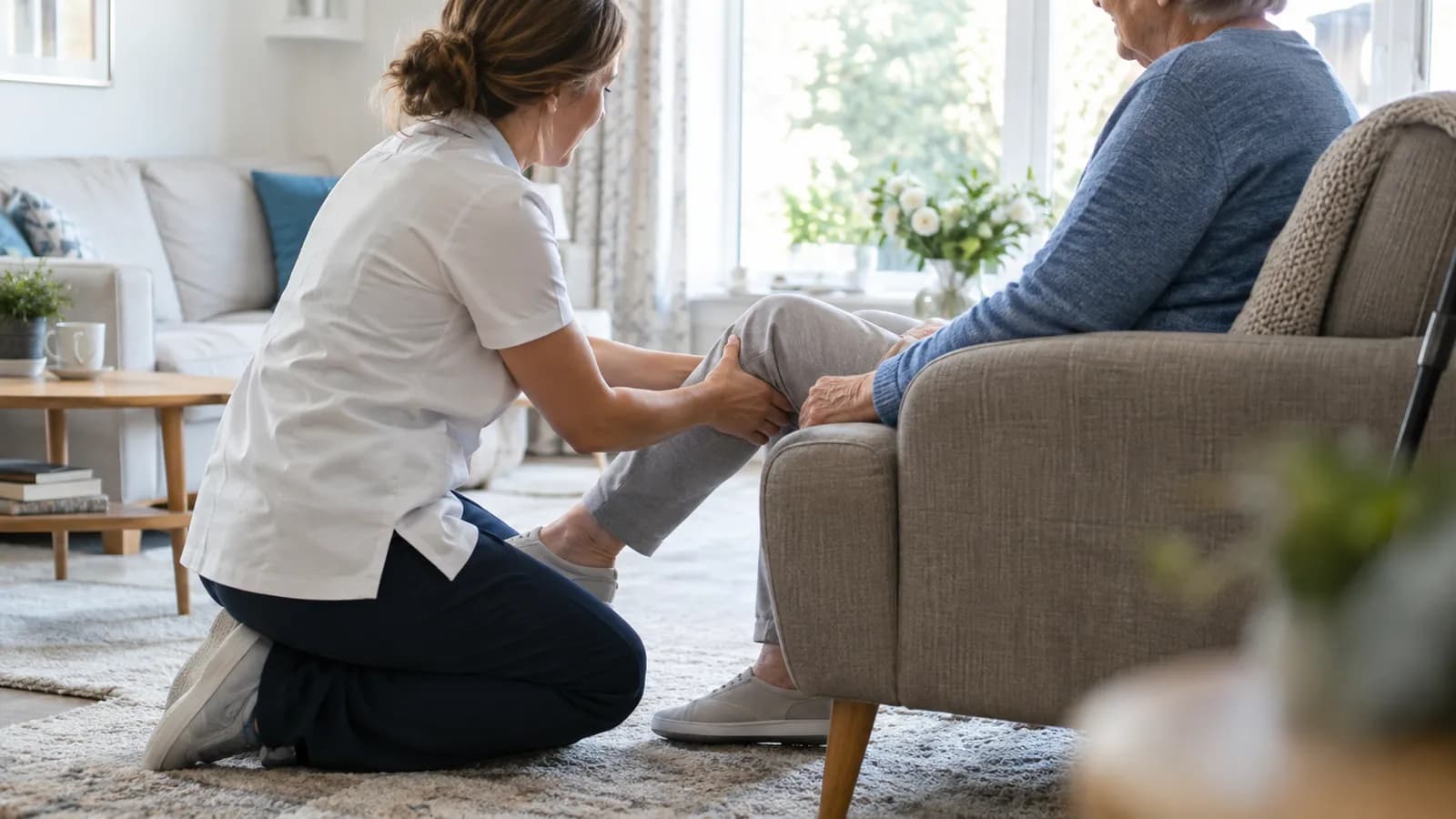
The deciding factor is not the diagnosis but whether the person can leave the house. If the journey to the clinic is harder than the treatment itself, working at home becomes the sensible option. These are the situations we visit most often:
- After a stroke: one-sided weakness, rebuilding walking, bringing the arm back into daily use. A process measured in months, not weeks.
- The first weeks after a hip or knee replacement: the surgeon has already set the movement limits, and working at home spares the patient the car journey in and out.
- After a fracture: the stiffness and loss of strength that remain once the cast or splint comes off.
- Fall risk in older age: someone who has fallen once, is afraid of the second fall, moves less because of that fear, and loses more balance as a result.
- Neurological conditions: in Parkinson's, multiple sclerosis or ALS the programme changes with the course of the illness; here consistency matters more than intensity.
- Bed-bound patients: the goal is not walking. It is protecting joint range, supporting breathing, and watching the skin and circulation.
There are situations where home physiotherapy is not the answer. New chest pain, uncontrolled blood pressure, a feverish infection or a suspected clot all come before physiotherapy, and a doctor sees the patient first. The scope of the service, the equipment we bring and the districts we cover are set out on our home physiotherapy page.
What happens in the first session
The first visit is spent looking rather than exercising. It usually takes 45 to 60 minutes and has three parts.
Assessing the patient. We ask for the discharge summary, the operation note, any imaging and the current medication list, and we write down the limits the doctor has set (no bending beyond a certain angle, only partial weight bearing). Then we measure joint range, muscle strength, balance and walking. We ask separately where the pain is, when it appears and which movement brings it on.
Walking through the home. How many steps from the bed to the toilet, how high the bed is, whether there is anything to hold on to when standing up, whether the edge of the hallway rug curls, what the patient stands on getting into the shower. None of this can be learned sitting in the living room; we need to walk the route.
Writing down the goal. The goal is yours and the patient's; our job is to make it measurable. “Getting better” is not a goal. “Reaching the toilet without help”, “sitting on the edge of the bed unsupported”, “walking to the front door with a stick” are goals. We usually pick a first goal close enough to reach in two or three weeks, because a goal that is actually reached is what keeps a patient going.
What can and cannot be done at home
We prefer to be clear about this at the start, so there is no disappointment halfway through a session.
Possible at home: range of motion, strengthening and balance exercises; walking and stair training; transfer training between bed, chair and toilet; manual therapy and soft tissue work; breathing exercises; electrotherapy and ultrasound with portable units; training for the person providing care.
Not possible at home: pool work cannot be brought to a flat. Isokinetic systems, robotic treadmills, body-weight support frames and stationary bikes stay in the clinic, and advanced balance work that needs open floor space cannot be done properly in a small living room. For some patients we therefore plan in two stages: at home until leaving the house is possible, then in the clinic. Where the aim is to ease muscle tension and support circulation, our mobile massage service can be built into the same visit.
The family's role: most of the work is yours

Two sessions a week are three hours out of a hundred and sixty-eight. What happens in the remaining time decides the outcome. That is why we spend the first visits teaching you three things.
- Transfers. Moving someone from bed to chair, you have to protect yourself as well. Pulling under the armpit injures the shoulder; the hold is on the trunk and hips, and the lift comes from your legs, not your back. Checking the bed brake and the wheelchair brakes every time is a rule, not a detail.
- Positioning in bed. The affected shoulder and hand are supported with pillows, the arm never ends up trapped under the body, and the ankle is watched so the foot does not drop. How long the patient sits up is part of the positioning too.
- Preventing pressure sores. For a bed-bound patient, changing position every two hours is the rule. Heels, tailbone, hip bones and elbows are checked daily; redness that does not blanch under finger pressure is the first sign, and that area carries no weight from then on. Wrinkle-free sheets and dry, moisturised skin do half the job.
We do not demonstrate these once and move on. On the second and third visits we watch you do them. A transfer learned wrongly turns into months of back pain for the person providing the care.
Setting up the home: preventing falls

For an older patient, the greatest threat to the treatment is another fall; a broken hip sends the whole process back to the beginning. The World Health Organization's fact sheet on falls notes that adults over 60 carry the greatest risk of fatal falls. What we suggest at home is not expensive:
- The bathroom comes first: grab rails beside the toilet and in the shower, a non-slip mat inside, a shower chair where it helps. A wet bathroom floor is the most dangerous surface in the house.
- Loose rugs are either removed or fixed down with anti-slip tape. A small rug with a curling edge is the most common thing people trip on.
- The route from bedroom to toilet has to be visible at three in the morning: a motion-sensor night light, or a switch within reach of the bed.
- Bed height is set so that the feet rest flat on the floor when sitting. A bed that is too low makes standing hard; one that is too high makes sitting down unsafe.
- Everyday items move to shelves between waist and eye level, so nobody has to climb on a chair or bend to the floor.
- Slippers matter more than they look: instead of backless slippers with smooth soles, a shoe that holds the heel and does not slide.
- A stick or walking frame must be set to the patient's height. A badly adjusted aid makes balance worse rather than better.
How often, and for how long
Frequency depends on the case. After joint replacement it is common to start with two or three sessions a week and space them out as the patient learns to do the programme alone. Stroke rehabilitation is measured in months, and here keeping the rhythm matters most. For a bed-bound patient the aim is maintaining what is there rather than arriving somewhere, so the programme can run without an end date.
We do not quote an exact number of sessions, and we would not trust anyone who does. Age, other conditions, medication, how the patient feels on the day and whether the programme is carried out between visits all change the timeline. What we do is plan in blocks of four to six weeks, measure at the end of each block, and decide again on what the measurements show.
How we measure progress
Progress is not tracked with “a bit better”. We repeat the numbers taken at the first visit at set intervals:
- Joint range in degrees with a goniometer: a knee moving from 90 to 110 degrees, for example.
- Sit-to-stand test: how many times the patient can rise from a chair in 30 seconds.
- Walking: how many metres along the hallway, in how many seconds, with what support (none, stick, frame).
- Balance: how long standing unsupported, whether turning requires holding on.
- Independence: how much help is needed with dressing, bathing, the toilet and moving between bed and chair.
- Pain: a score from 0 to 10, with which movement and at what time of day.
These numbers help the family as much as us. In a month where nothing looks different to the eye, seeing the sit-to-stand test go from 6 to 9 makes it easier to carry on. The reverse is just as useful: if the numbers fall two blocks in a row, either the programme changes or the patient goes back to the doctor.
When to call a doctor instead of us
Some situations can wait for a physiotherapy appointment and some cannot. If any of the following appears, postpone the session and contact a doctor, or emergency services where the picture calls for it:
- Sudden weakness, a drooping face, slurred speech or sudden loss of vision. This can be a stroke; minutes count, call 112.
- Shortness of breath, chest pain, a heart rhythm that suddenly races.
- Fever above 38 °C, shivering, a clear deterioration in general condition.
- New one-sided swelling in a leg with warmth, redness and calf pain. Where a clot is suspected, that leg gets neither massage nor exercise.
- Discharge, bad smell or opening of the surgical wound.
- New severe pain after a fall, or a leg that looks shortened or turned outwards.
- New loss of bladder or bowel control, or numbness spreading quickly in the legs.
If you are unsure, call. Asking is always better than waiting to see.
Most of the older adults we see at home also have knee pain, and that is usually what shortens their walking distance. how exercise works in knee osteoarthritis is covered in a separate article, including four movements you can do at home.
If you would like our physiotherapist to visit a home in Antalya or the Muratpaşa area, you can leave a request on our appointment page. Having the medical report, the operation note and the medication list ready makes the first session quicker. We can also speak in English about the layout of the home and the patient's daily routine before we come.
This article is for information only and does not replace medical examination, diagnosis or treatment. A rehabilitation programme is planned together with the assessment and recommendations of the doctor following the patient.