Almost everyone who walks into the clinic with this problem opens the same way: when I lift a glass of water, the outside of my elbow hurts so much that I drop it. Turning a key, lifting a full kettle and tightening a screw all land in the same spot. The pain is not in the palm; it sits on the bony bump on the outer side of the elbow and sometimes spreads down the forearm as a dull burn.
The next sentence is usually this one: but I have never played tennis in my life. They are right, the name is misleading. The people we see with this picture prune and pick in greenhouses, lift pans in hotel kitchens, repaint an apartment over a long weekend, work all day with hairdressing scissors, or spend eight hours on a mouse and keyboard. A racket is near the bottom of that list. This article explains why the name confuses people, and why the correct treatment is often the opposite of what patients expect.
What is actually happening on the outside of your elbow
On the outer side of your elbow there is a bony bump you can feel with your fingers: the lateral epicondyle. The forearm muscles that lift your wrist and fingers share a common tendon attaching exactly there. Every time you grip something, those muscles work to stabilise the wrist, even when the wrist is not moving. That is the link between gripping and pain on the outer elbow.
Because the old name ends in "-itis", almost everyone assumes this is inflammation. Yet tissue taken from the area usually does not show the classic inflammatory picture. What we see instead is structural wear of the tendon: collagen fibres losing their orderly arrangement, micro-damage outpacing repair, and disorganised new blood vessels. That is why the more accurate term today is tendinopathy, a disease of the tendon rather than an inflammation of it.
This is not an academic detail; it changes the whole plan. If you assume inflammation, the answer is ice and rest. In a worn tendon, complete rest makes the tissue weaker still, because a tendon needs controlled loading to reorganise itself. The sentence that surprises patients most is this: not using your arm at all does not speed up recovery, it delays it. If you would like a neutral overview, the NHS page on tennis elbow is a clear and reliable starting point.
Who gets it? Usually middle-aged people who grip firmly for a living, and nearly always on the dominant arm. Most cannot point to a single injury; they remember an unusually heavy week instead, such as a weekend of pruning or painting a whole flat. In people who do play racket sports, the problem is rarely the sport itself but the technique and the equipment: a backhand hit with the wrist bent back, a racket that is too heavy, a grip that is too thin.
What we look for during the examination
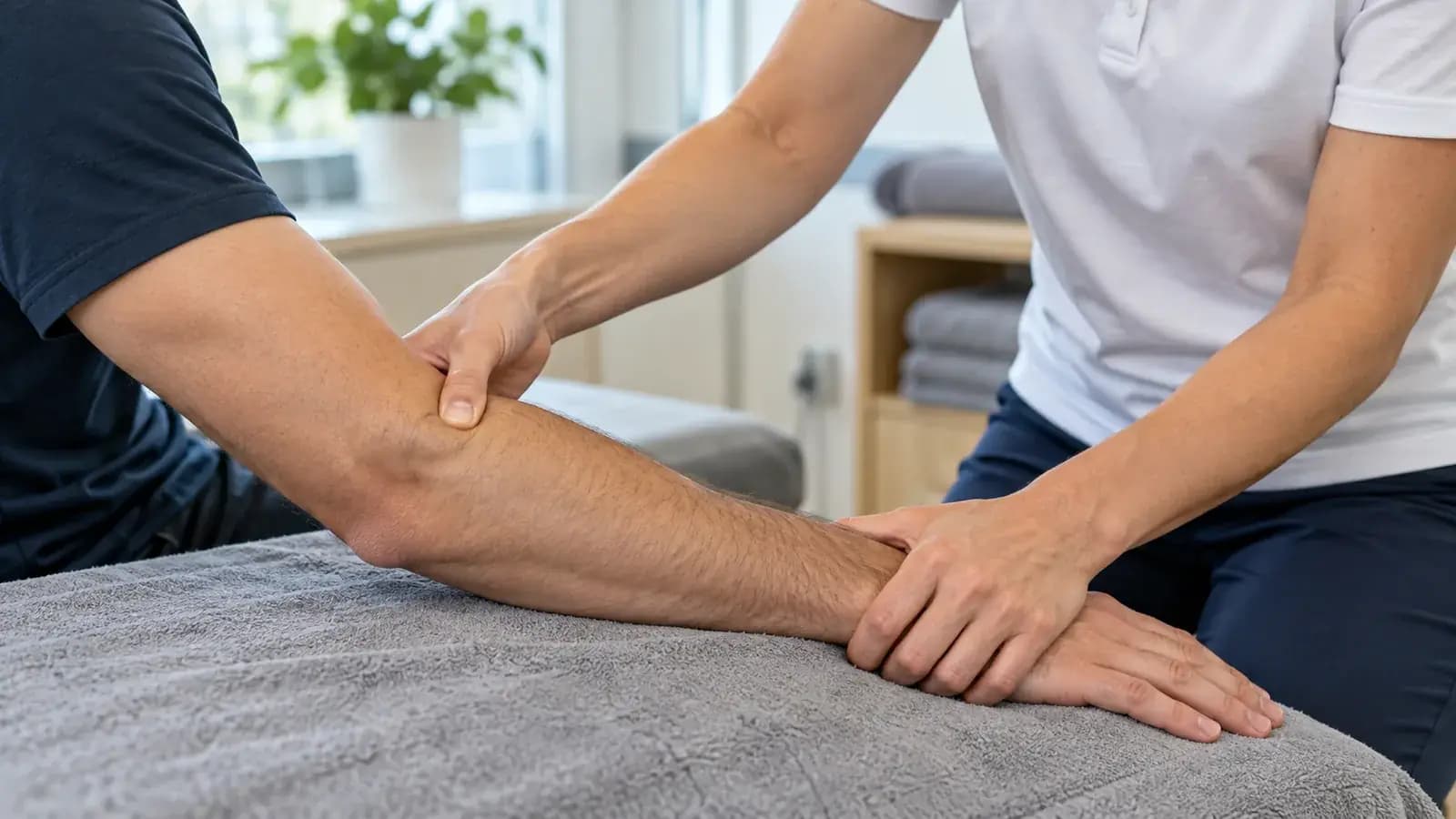
In this condition the diagnosis rests mainly on the history and a careful hands-on examination. We work through the following:
- A tender point on and just below the bony bump that reproduces exactly the pain the patient describes, not a vague soreness nearby.
- Resisted wrist extension with the elbow straight. If this provokes the pain, the common tendon is being loaded. When the same test hurts far less with the elbow bent, that contrast is meaningful for us.
- The middle-finger test: with the arm reached forward and the elbow straight, we resist the middle finger alone. Pain felt on the outer elbow supports the diagnosis.
- Grip strength measurement. We compare both sides and record the pain-free grip threshold, the follow-up measure we trust most: patients forget how the pain felt, numbers do not.
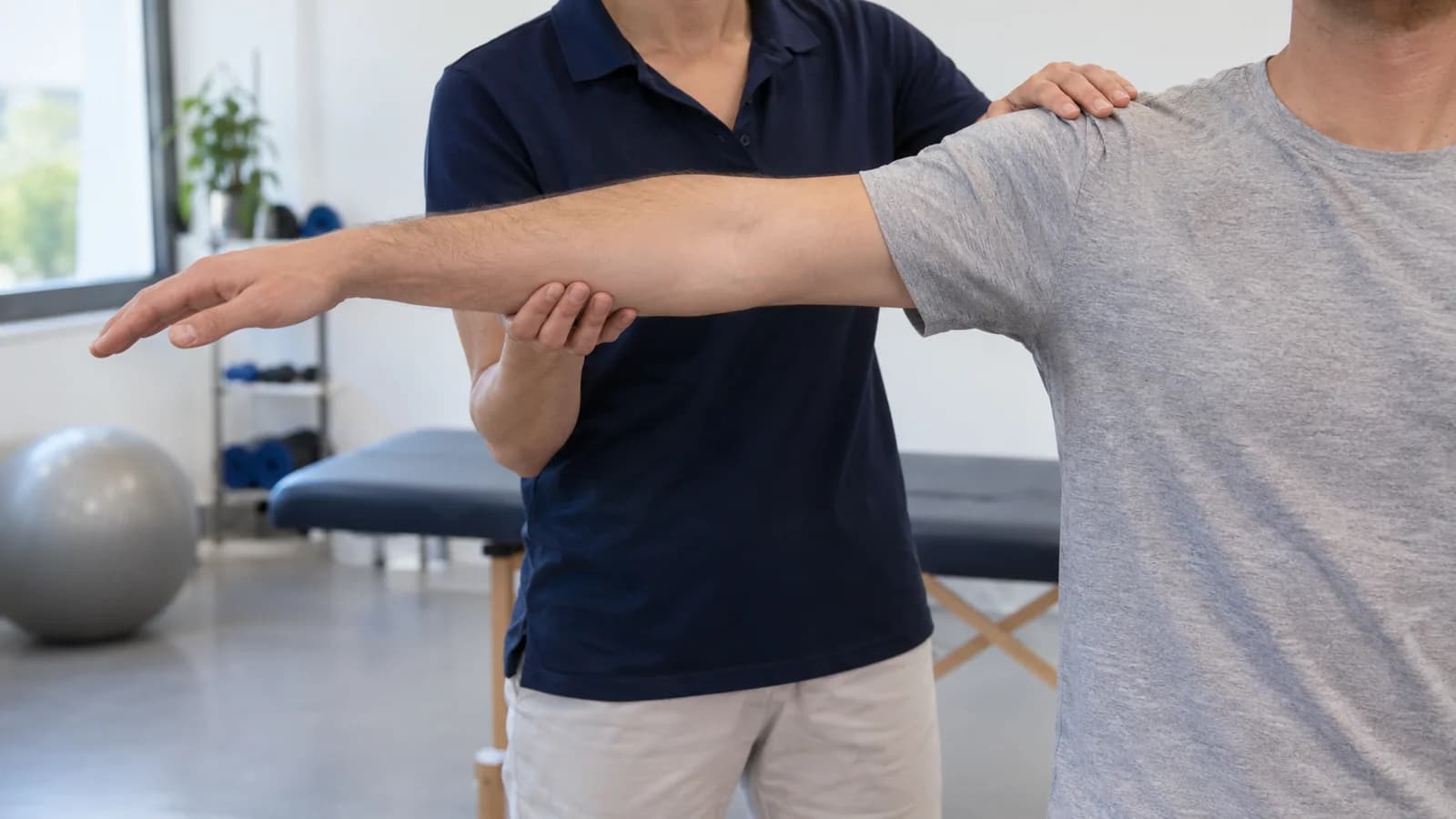
- An examination of the neck, shoulder and wrist. Looking at the elbow in isolation leaves the job half done.
Imaging is usually not needed at the first visit. With a history of trauma, swelling or locking in the joint, or an unusual pattern of pain, the doctor may request an ultrasound or MRI scan.

Not every outer elbow pain is tennis elbow
This is the misunderstanding we correct most often. Pain on the outside of the elbow has at least three other possible addresses:
- Pain referred from the neck. Irritation of a nerve root at the fifth or sixth cervical level can project pain to precisely this spot. The clues: the pain changes when you turn your head or look up, there is tightness between the shoulder blades, or the arm feels numb or generally weak.
- Radial nerve entrapment in the forearm. The pain feels deeper, more spread out and often disturbs sleep. The tender point is not on the bony bump but a little lower, inside the muscle bulk.
- A problem inside the elbow joint itself, such as cartilage damage, a loose fragment or arthritis. Here the picture is mechanical rather than purely painful: restricted movement, catching or locking, swelling.
When pain is coming from the neck, weeks of elbow treatment will not help. The patient concludes that physiotherapy does not work for them, when in reality the treatment was applied to the wrong place. With any arm or hand complaint, our first job is to confirm the address of the pain.
If numbness in the hand is part of your picture as well, we described how we separate a wrist problem from a neck problem in our article on carpal tunnel syndrome. The same logic applies to the elbow: address first, treatment second.
Treatment: managing the load rather than stopping it
The first thing we say is not that you should stop working. Telling someone who works in a greenhouse to rest for three months has no meaning in real life. Instead we reduce the load in measured steps and change how the movement is performed: lifting heavy objects with the palm facing up, splitting a one-handed grip between both hands, thickening a tool handle so the same job needs less grip force.
The exercise programme runs in two stages. While pain is high we start with isometric work: the muscle contracts but the joint does not move, in holds of several seconds. This stage teaches the tendon to accept load again and settles the pain for a while in most patients. Once pain is under control we move to eccentric loading: lifting the wrist with help from the healthy hand, then lowering it slowly with the painful side. Loading a tendon while it lengthens is the main stimulus for remodelling.
The dose is set by the response, not by a fixed number. Mild, tolerable discomfort during the exercise is acceptable; a programme that leaves the elbow worse the next morning was too much. We remeasure every couple of weeks and increase the load according to the numbers.
These are the everyday adjustments we have seen actually help:
- Lift heavy objects with the palm up, using both hands and keeping the load close to your body. Palm-down lifting stresses the common tendon the most.
- Break up long grips: carry a bucket in two trips, take a loaded tray with both hands.
- Thicken the handle of the tool, knife, scissors or pruning shears you use most. A thicker grip does the same job with less force.
- Build a rhythm into repetitive work: every forty-five minutes, take a minute or two to open the hand and stretch the fingers.
- At a desk, move the mouse with the whole arm rather than the wrist, do not rest the wrist on the table edge, and avoid a keyboard height that bends the wrist backwards.
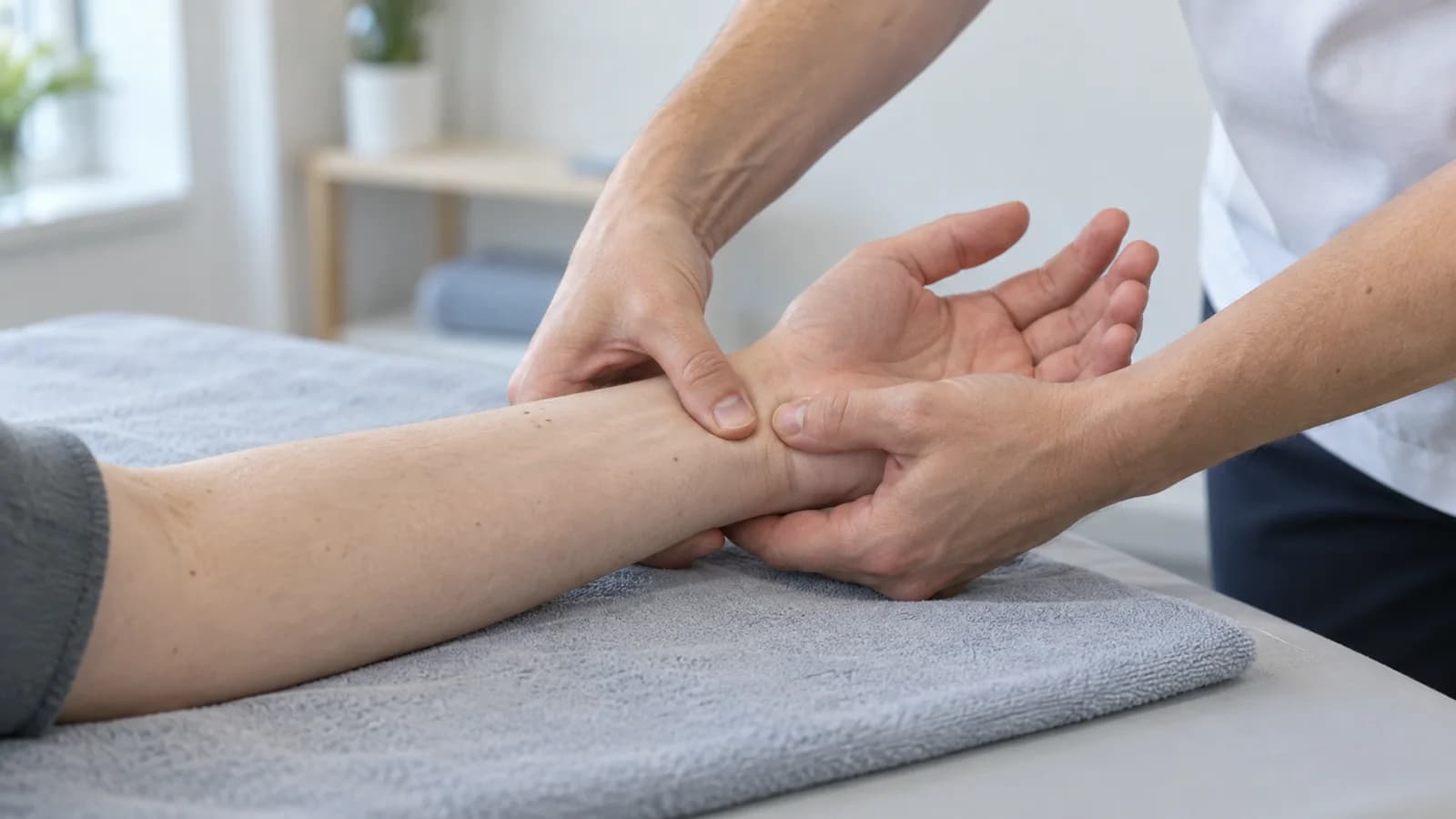
Hands-on work runs alongside all of this: soft tissue treatment for the forearm muscles, techniques for the elbow and wrist joints and, where we think it helps, fascial work with the Graston technique. What manual treatment involves in general is described in our article on manual therapy. None of it replaces the exercises: it makes the work easier, it does not do the work.
Braces, cortisone and the patience problem
Let us be straightforward about epicondylitis straps. Worn correctly, one can take part of the load off the tendon and reduce pain, which genuinely helps someone who has no choice but to keep working. But a strap does not heal the tendon; it masks the symptom. Increasing your workload because the strap quietened the pain is one of the most common reasons we see people slide backwards.
Cortisone injections deserve the same honesty. In the short term they bring quick relief, and within a few weeks a patient may feel almost symptom-free. Over longer follow-up, however, recurrence has been reported more often in injected groups: fast relief does not guarantee long-term recovery. This is a decision for the doctor; where an injection has been given, we continue the same loading programme with appropriate timing.
Finally, we set expectations honestly from the start. Recovery here is measured in weeks, sometimes months, not days, and this is the part patients struggle with most. Stopping the exercises when the pain eases in the third week is the most common cause of relapse we see, because the tendon has not yet regained its capacity. We end a programme when your grip strength and your endurance through the working day have returned, not simply when the pain has gone.
Do not wait if you notice these
The following are not situations to watch a little longer; they need a medical assessment:
- Pain that persists at rest during the night or wakes you from sleep.
- Swelling, warmth, locking of the joint, or an inability to straighten and bend it fully.
- Pain that started after a fall, a direct blow or a sudden forceful strain.
- Numbness spreading into the hand or fingers, and progressive loss of strength.
- No change at all despite several months of a correctly performed programme.

In Antalya you still have to use your arm
Most people who come to us cannot simply stop: greenhouses, kitchens, workshops, salons and tourism shift work carry on. So our job is not only to hand out exercises; it is to work out with you which movement loads the tendon most and how to do the same task with less load. At our clinic in Muratpaşa we examine the neck and shoulder girdle along with the elbow, because the source of pain is not always where it hurts.
If your outer elbow pain has lasted more than two weeks and is getting in the way of tasks that need gripping, you are welcome to come in for an assessment. Depending on what we find, we will either start the loading programme together with hands-on treatment, or tell you plainly that the right next step is a medical evaluation.