"My MRI says I have a meniscus tear, and my knee sometimes catches." We hear some version of this sentence from knee patients at our clinic very often, followed by one question: will I need an operation? The honest answer depends less on the word in the report than on the type of tear and how the knee behaves when we examine it.
In Turkey an MRI is easy to get, so international patients often arrive with a report before anyone has examined the joint itself. Below we explain the two very different pictures behind a meniscus tear, catching versus true locking, and where rehabilitation helps and where it falls short. To be clear from the start: not every meniscus tear needs surgery, but some tears genuinely do need a surgical opinion, and that should not be delayed.
What is the meniscus, and what does a tear mean?
The meniscus is a pair of crescent-shaped cartilage cushions sitting inside the knee, between the thigh bone and the shin bone. The one on the inner side of the leg is the medial meniscus, the one on the outer side is the lateral meniscus. They spread body weight across the joint, add to knee stability and protect the joint cartilage every time you walk, take the stairs or squat.
"Tear" sounds alarming, but on an MRI report it can mean anything from a small frayed edge to a piece of meniscus that has shifted into the joint. These do not all need the same treatment.
Two different pictures: a sports injury and a wear-related tear
The first is the traumatic tear: usually in a younger, active person, caused by twisting on a bent knee while the foot is planted. A sudden change of direction on a five-a-side pitch or landing with a twist in the sand during beach volleyball are typical examples. People usually remember the moment, and the knee swells within a day. Even so, some small, stable tears without mechanical symptoms can be managed with rehabilitation; if a young knee may have a repairable tear, though, a doctor's opinion should be sought early.
The second is the degenerative tear: it develops slowly, usually after the age of 40, without a clear injury. The meniscal tissue wears over the years and can tear during something as ordinary as getting up from a squat. This kind of tear is often part of knee osteoarthritis. Worth knowing: degenerative meniscus tears are frequently seen on the MRI scans of middle-aged and older people who have no knee pain at all. So a tear on the scan does not necessarily mean the tear is the source of the pain. Pain is often fed by the joint's overall condition, muscle weakness and daily loading. That is why our approach is very close to the one we describe in our article on why exercise comes before medication in knee osteoarthritis.
We treat the knee, not the MRI image. The scan is one part of the picture; how the knee moves and what the person can no longer do in daily life matter at least as much.
Symptoms: catching, or true locking?
The complaints we see most often with a meniscus tear are:
- Pain along the joint line, the line on the inner or outer side of the knee, that you can point to with one finger
- Swelling that builds after activity or towards the end of the day
- A catching or clicking sensation when turning, squatting or using stairs
- Pain that increases with deep squatting, sitting cross-legged or kneeling
Many patients tell us their knee "locks", but two different things need to be separated here. Temporary catching is when the knee sticks for a moment and then frees up after a few movements or on its own. This is common and not, by itself, a reason for surgery. True locking is when the knee cannot fully straighten and does not free itself: the person cannot extend the leg, as if something were wedged inside the joint. That picture suggests a displaced piece of meniscus and needs a doctor's assessment.
A hotel housekeeper who kneels to clean under beds all shift and says "my knee is swollen by the end of the day" is describing a different problem from someone whose knee is stiff in the morning but loosens up during the day. Noting which movement starts the pain and when the swelling appears makes the examination far more useful.
What we look at during the examination, and how to read the MRI report
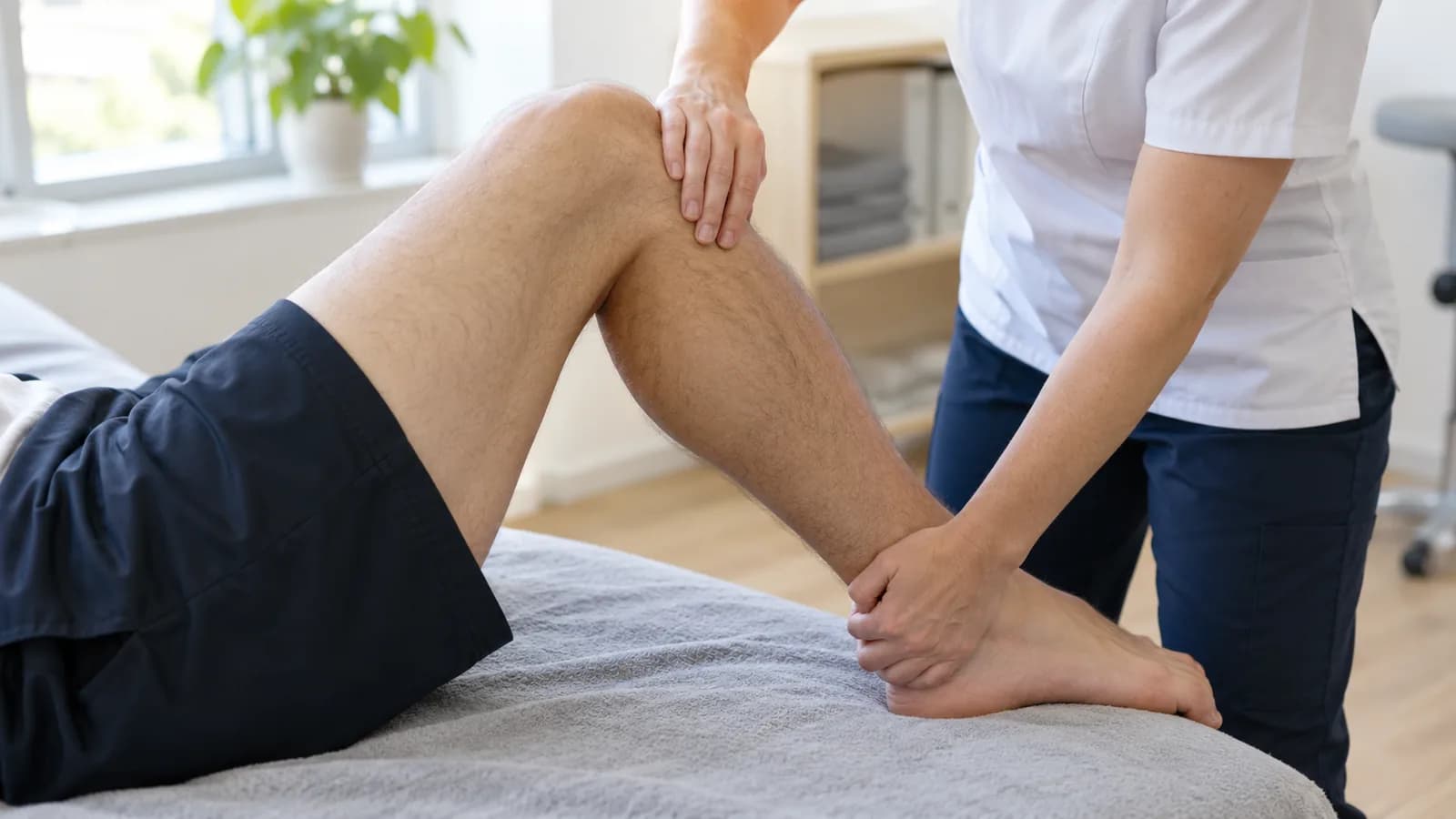
When someone arrives with an MRI report, we put the report aside first and examine the knee. Is there tenderness along the joint line, and on which side? Can the person squat, and at what angle does pain begin when getting up? Does the knee bend and straighten fully, or is range of motion lost? How strong is the quadriceps, the muscle at the front of the thigh, and is there visible wasting? With ligament tests we check whether the anterior cruciate ligament and the collateral ligaments are lax. We also assess hip strength and single-leg balance.
Then we read the MRI report alongside the examination. If the report describes a medial meniscus tear, the tenderness sits exactly on that joint line and the symptoms fit with twisting movements, the two findings support each other. But if the report mentions a tear while the pain is around the kneecap at the front of the knee, or if signs of osteoarthritis dominate, the real source of the pain has to be looked for elsewhere. Read on its own, the report can cause needless worry about surgery or hide other problems.
Rehabilitation: why exercise is the first step for degenerative tears
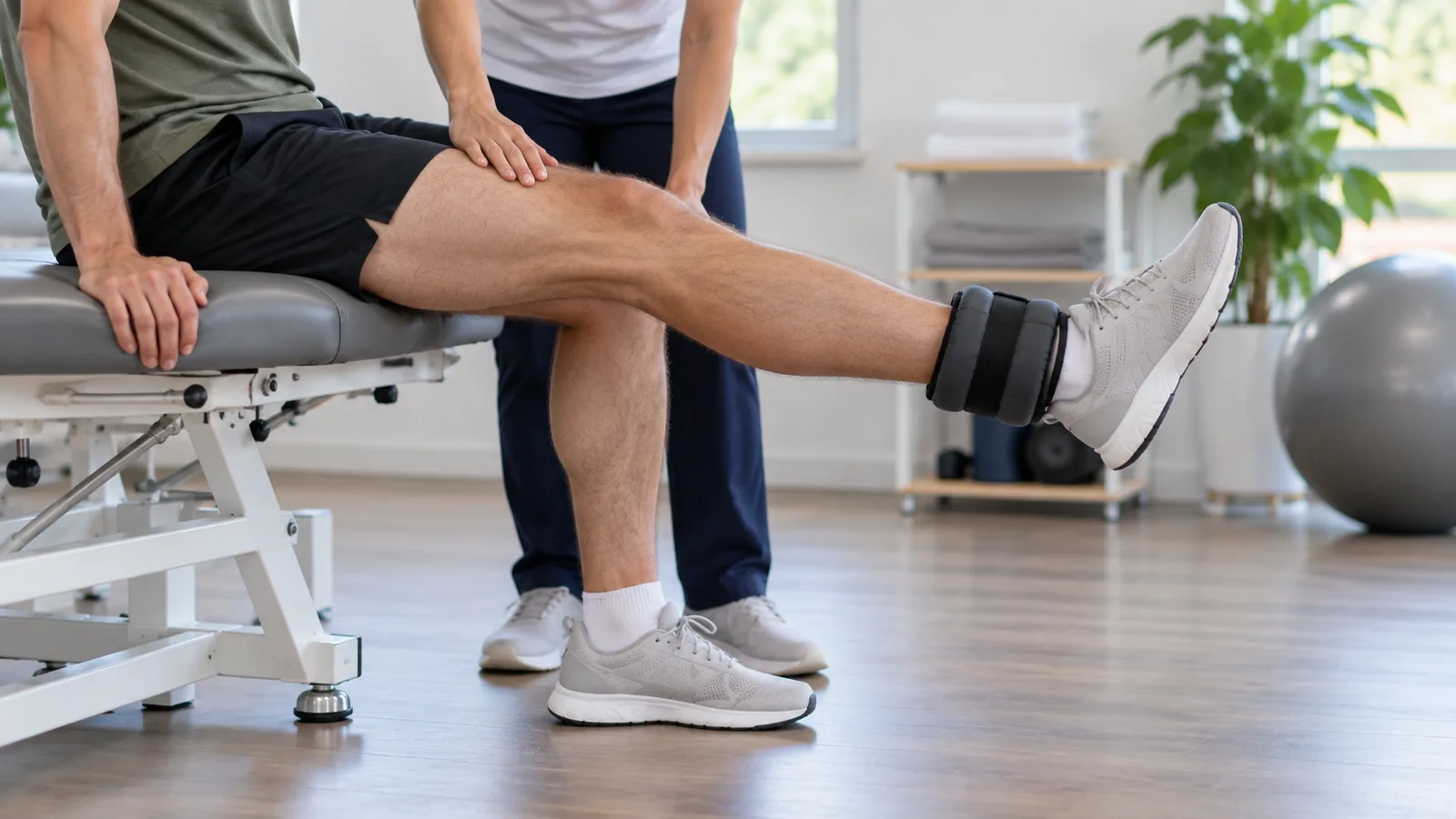
In current practice, exercise-based rehabilitation is the first step, especially for degenerative tears in middle-aged and older people. Comparative studies have shown that arthroscopic trimming of the torn edges (debridement) is, for most degenerative tears, no better than a structured exercise programme. For an independent overview, the NHS page on meniscus tears is a good place to start. We build each programme around the individual, but the main elements are usually:
- Quadriceps and hip strengthening: the front thigh muscle works like the knee's shock absorber, and the hip muscles stop the knee from collapsing inwards.
- Load management: rather than banning painful movements altogether, adjusting walking time, stairs and time spent standing.
- Balance and single-leg control exercises.
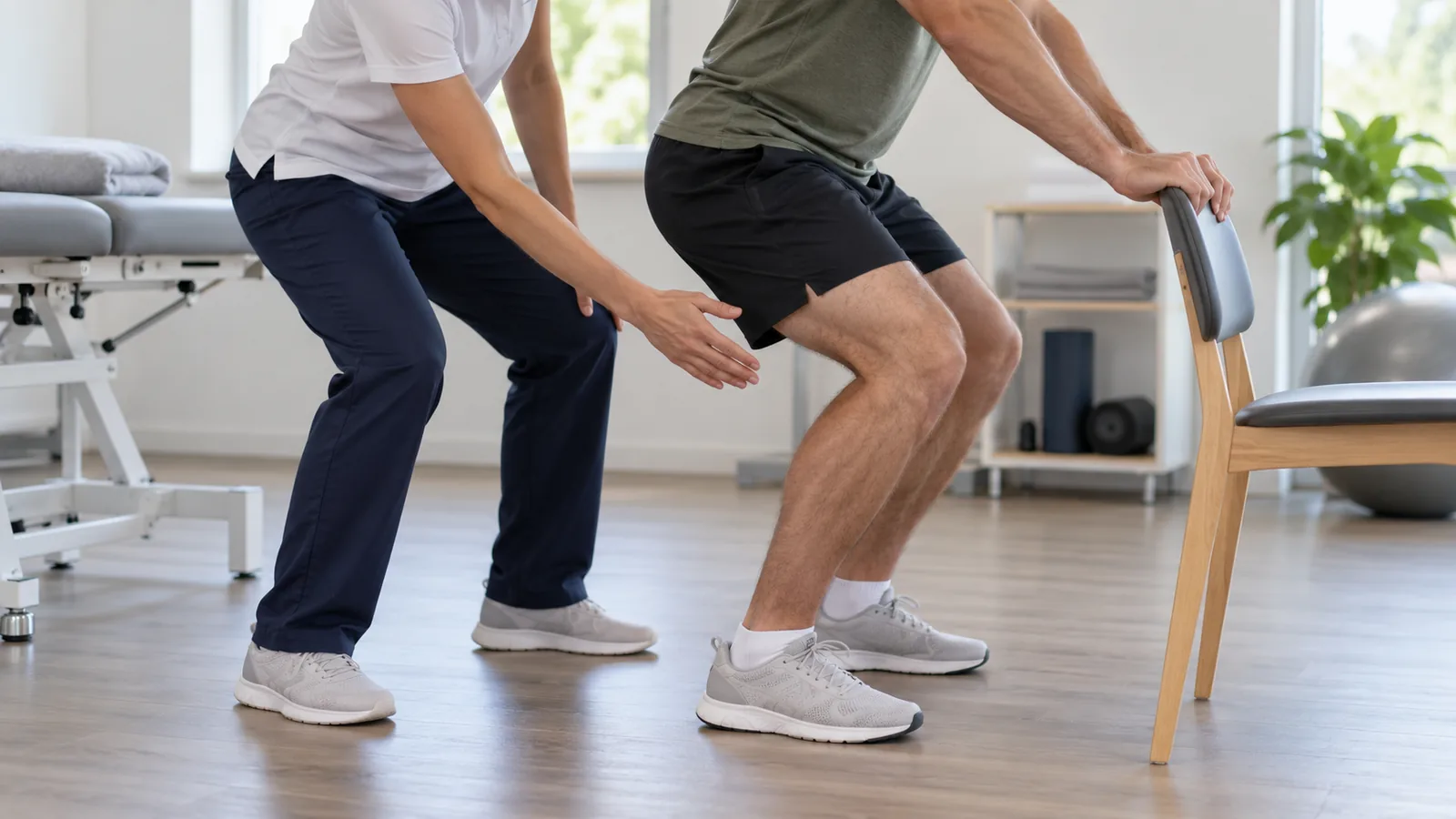
- Graded squatting: starting at shallow angles and going deeper as pain allows.
- Return to running and sport: from straight-line running to changes of direction and jumping, step by step.
In Antalya this programme has to fit the person's work. For a cook who squats to reach low shelves in a hotel kitchen all day, a greenhouse worker who plants seedlings on their knees, or someone living on the upper floor of an older building without a lift, squatting and stairs are not items on an exercise sheet; they are the real load of every hour. Knee pads, a low stool or using the handrail are part of the programme too. Where needed, we use manual therapy to ease soft tissue tension and stiffness around the joint as a support to exercise, but the exercise does the main work.
To be honest: rehabilitation does not "glue" the tear back together. The goal is for the knee to carry load again, for pain to settle and for the person to get back to work and sport. Results do not come in a few sessions; they take weeks of consistent work, and not everyone improves to the same degree.
We track progress by measuring: pain-free squat depth, single-leg balance time, going down stairs and thigh strength, repeated a few weeks later. If these measures are not improving, or the catching is getting worse, we do not simply change the programme; we refer the patient back to a doctor.
When does surgery come into the picture?
The decision to operate belongs to the orthopaedic surgeon. Our job is to refer without delay when we see certain situations. True mechanical locking, where the knee will not straighten and stays that way, comes first. A suspected bucket-handle tear, in which a long piece of the meniscus has flipped into the middle of the joint, usually shows itself with a marked loss of movement. A traumatic tear in a young patient that looks repairable, a tear that comes together with an anterior cruciate ligament injury, and mechanical symptoms that persist despite an adequate period of consistent rehabilitation also call for a surgical opinion.
Repair (stitching) means sewing the torn meniscus so it is preserved; it is considered mainly in younger people and in suitable tears in the area with a good blood supply. Partial removal means taking out the torn part. Because the meniscus is the knee's cushion, keeping as much of it as possible is valuable for long-term joint health. Ask your surgeon which method is suggested and why, rather than thinking "it's only keyhole surgery".
If you have had surgery, rehabilitation becomes important again: after a repair there are usually restrictions on weight-bearing and bending for a while, whereas after partial removal the programme tends to progress faster. We cover this in detail in our article on rehabilitation after surgery: when to start and what to expect.
When to see a doctor or go to A&E straight away
Some situations should not wait for a physiotherapy appointment. If the knee swells rapidly and markedly within the first hours after an injury, there may be bleeding inside the joint. The same applies if the knee will not straighten at all, if the swelling comes with fever, redness and warmth, or if you cannot put weight on the leg. These can point to a ligament injury, fracture or joint infection.
In a young player who twists the knee on the pitch and finds it swollen like a balloon the same evening, the anterior cruciate ligament may be injured along with the meniscus. A doctor's examination and imaging come first; the rehab plan follows. A similar warning applies to those who roll an ankle on the same pitch; we cover that separately in our article on recurring ankle sprains.
If pain along the joint line, swelling after activity or a catching sensation in your knee has lasted longer than two weeks, you are welcome to come to our clinic for an examination, with or without an MRI report. We will look at the report together with the examination and tell you clearly whether rehabilitation is the right first step for you, or whether you should see a doctor first.