Many patients hear the word osteoporosis for the first time only after something has broken. The sentence we hear most often goes like this: "I didn't fall from any height, I just slipped on the wet marble at the entrance of my building, put my hand down, and my wrist broke." That one sentence tells us the most important thing about this condition. Osteoporosis does not hurt, it progresses quietly, and it usually announces itself with a first fracture.
There is a second, quieter group: a bone has already broken and the person never knew. They tell us "I have lost height, my old trousers drag on the floor", or "my back has rounded and I cannot stand for long". This article separates two questions that get mixed up: which movement genuinely strengthens bone, and how to prevent the fall that causes the fracture. One boundary up front: diagnosis and medication belong to the doctor. We work on the movement side.
Why osteoporosis stays silent for so long
Bone is not a stone-like structure but living tissue, constantly broken down and rebuilt. In youth rebuilding wins; with age the balance shifts towards loss, and in women the drop in oestrogen after menopause makes that shift noticeably faster. While bone thins, nothing irritates the nerve endings, so there is nothing to feel and no warning in daily life.
When a fracture comes, we see three regions most often. The wrist comes first, because we put a hand out when we fall, and it is often the earliest warning. The spine is the most commonly missed site: compression fractures can happen while bending to lift something or even during a hard sneeze, and people dismiss it as a pulled back. As several vertebrae compress over the years, height is lost, the upper back rounds and breathing becomes harder. The hip carries the heaviest consequences, because it threatens independent living and needs long rehabilitation.
If you would like to read the general picture from a neutral source, the NHS page on osteoporosis is clear and reliable.
Who is at higher risk: menopause, medication and the Antalya sunshine illusion
In the assessment we go through the risk list:
- The post-menopausal years and falling oestrogen; early menopause or removal of the ovaries raises risk further
- Older age and low body weight
- A family history of hip fracture, particularly on the mother's side
- Smoking and heavy alcohol use
- Long-term corticosteroid (cortisone) treatment, for asthma, a rheumatological condition or anything else
- Inactivity: long bed rest, the weeks after a cast, a life spent almost entirely seated
- Insufficient vitamin D and calcium
- Thyroid and parathyroid disease, coeliac and other absorption problems, rheumatoid arthritis
Living in Antalya, you might assume we never see vitamin D deficiency. We see the opposite. Most of our patients spend the whole day indoors: greenhouses, hotel kitchens, housekeeping, shops and offices. And in summer everyone sensibly avoids the sun; nobody stands outside between eleven and four, and those who do are covered up. Living in a sunny city does not guarantee your vitamin D level. That level comes from a blood test, not a guess, and if it is low the dose and duration are your doctor's decision. With calcium we look at the diet first; supplements are the second step.

Diagnosis and medication belong to the doctor: DEXA and fracture risk
We want to be explicit about the boundary. Osteoporosis is diagnosed with a bone density measurement, the DEXA scan. Your doctor reads the T-score together with your age, previous fractures, family history and steroid use to estimate fracture risk, and starts medication when it is needed.
A physiotherapist does not diagnose osteoporosis, does not read a DEXA result to start medication, and does not stop or change the medication you are on. When patients ask whether exercise can replace their tablets, our answer is short: that is your doctor's decision. And no tablet stops your foot slipping on wet marble.
Exercise does not replace bone medication, and medication does not prevent falls. These two are not alternatives to each other; they are two halves of the same plan.
Bone responds to load: what actually works
The logic of bone is simple: it responds to load. When muscle pulls on bone and the foot carries body weight against gravity, bone-building cells are stimulated. No load means no stimulus, which is why bone weakens so fast during long bed rest.
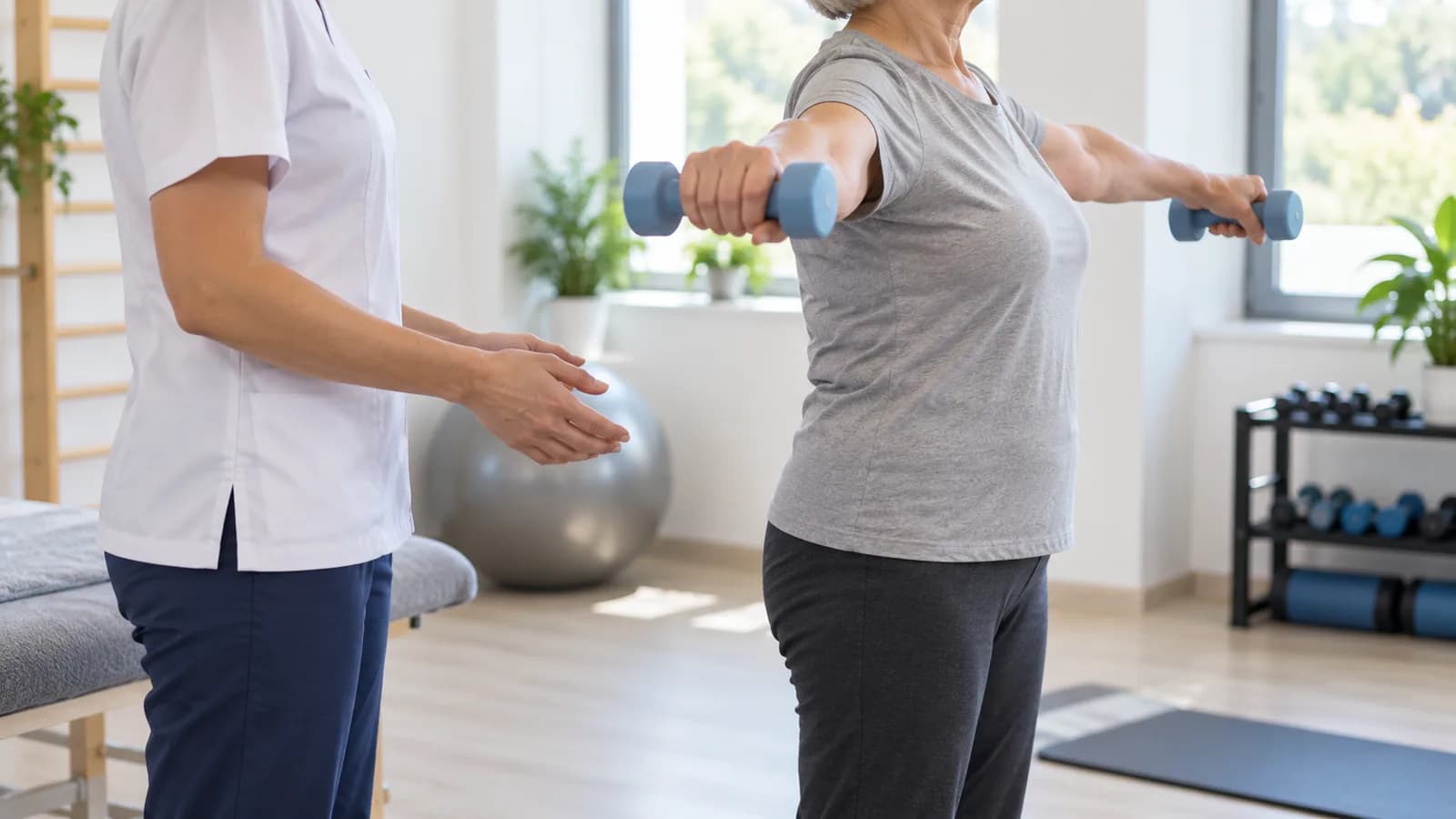
The work that stimulates bone has four parts. The first is walking and weight-bearing activity: brisk walking, taking stairs, standing exercises with light weights. Spread across most days of the week, this works better than one long walk crammed into the weekend. The second is progressive resistance training for the hips, legs and especially the back, two or three days a week. Progression matters; the same band and repetitions for months stop being a stimulus.
The third is the strength of the back extensors, the group that carries the trunk against gravity, supports posture and shares spinal load; in osteoporosis it deserves its own heading. The fourth is balance training: single-leg standing near a support, standing with the feet in line, walking with changes of direction — short sessions, often, ideally daily.
One point calls for honesty. Swimming and cycling are valuable for cardiovascular health and we often recommend them to patients with painful joints, but neither puts body weight through the skeleton, so their contribution to bone density is limited. We are not telling you to stop swimming; something upright and weight-bearing has to sit alongside it.
Progression needs nothing dramatic: start with a load you handle comfortably, add a little every two or three weeks, and step back if soreness spills into the next day. Where you start depends on your bone density, fracture history and fall risk, which is why generic online programmes carry real risk.
Movements that need care when bone is fragile
A spine with weakened bone does not tolerate forceful movements that combine bending and twisting. These are the headings we discuss most often:
- Fast, forced forward bending combined with trunk rotation: turning while picking something off the floor, or yanking a heavy hose or bucket around in the garden
- Traditional sit-ups and similar forced trunk curling, which load the front of the vertebral bodies unnecessarily
- Lifting something heavy off the floor with straight knees and a rounded back. Instead bend the knees, keep the load close and turn with the feet rather than the spine; we set out that lifting logic in our article on lower back pain
- Activities with a high risk of falling: hurrying across a wet floor, changing direction quickly in a crowded class, taking stairs two at a time, or climbing onto a chair
If there is a history of vertebral fracture, the programme must be individual. A general group class is not enough, because several movements in the classic Pilates repertoire involve forward flexion and are wrong for that spine. In our clinical Pilates sessions we use adaptations that keep the trunk neutral and teach the spine to carry load rather than curl under it.
What breaks the hip is the fall more than the bone
Almost every hip fracture happens in a fall, so talking about bone density without talking about falling skips half the job. The practical difference matters: changing bone density takes months or years, while fall risk can drop within weeks.
- Rug and carpet edges: secure curling edges or use a non-slip underlay
- Cables on the floor, and boxes or bags left in walkways
- Night lighting between bedroom, hallway and bathroom; feeling your way in the dark is a common cause of falls
- A grab rail and a non-slip surface in the bathroom, and something solid to hold at the bath
- Footwear: a closed shoe with a sole that grips instead of backless slippers indoors
- Vision: an annual eye check and current lenses, with extra care on stairs for varifocal wearers
- Medication: review anything causing dizziness or drowsiness, and blood pressure tablets, with your doctor
- Blood pressure dropping on standing: rise slowly and wait a second or two before walking
Antalya adds its own hazards: the sloping, stone-paved streets around Kaleiçi, older buildings with no lift and high uneven steps, and wet marble. When a building entrance or hotel lobby has just been washed that marble turns to ice, and the same after rain. We hear these three elements again and again from patients who come after a fall. For people who cannot manage the stairs, or who have stopped going out because they fear falling, home physiotherapy is often the most realistic start.
Then there is the fear of falling itself. After one fall most people become cautious: no more walks, no crowds, no stairs. As activity drops, leg strength and balance fade, and as they fade the risk rises again. We see this circle constantly, and the way out is not telling someone to be careful; it is raising strength and balance measurably in a safe setting.
The movement side is well established: strength and balance work together reduce how often people fall. As a frame: two or three strength sessions a week plus a short balance session on as many days as possible. Difficulty rises step by step: first holding the kitchen counter, then one finger on it, then no support, and only then adding head movement or changes of direction. Patients who skip that order fall during the exercise itself.

How we work in the clinic
With a patient who arrives with a diagnosis, or with the worry that precedes one, we measure first: posture, back and hip strength, balance and gait, rising from a chair, falls history and fear of falling. Then we build an individual strength programme, prepare the spine for loading with safe clinical Pilates-based trunk work, and go through home safety. We re-measure every three months or so, because an unchanged programme stops stimulating bone.
We also keep an eye on the medical side: whether a DEXA scan is due, whether vitamin D has been checked, whether steroid use or any medication contributing to falls has been reviewed. If you are past menopause, if there is a hip fracture in your family, if you suspect you have lost height, or if you have fallen even once in the past year, you are welcome to come in for an assessment. Your doctor makes the diagnosis; our job is the programme that loads the bone, restores balance and makes a fall less likely.