
"I started running, and by the third week the front of my knee began to hurt." We hear some version of this sentence again and again at our clinic, especially in spring and autumn, when the weather in Antalya finally becomes kind to runners. The person is usually motivated: new shoes, a new app, two good weeks. Then one morning the front of the knee aches on the way down the stairs, or the inner edge of the shin starts to burn in the first minutes of a run.
Below we explain the problems we see most often in new runners, why they appear and how to build up without getting injured. Our aim is not to talk you out of running but to help you keep it up for years.
The real problem is usually "too much, too soon"
When we go through the last few weeks with a patient, the story is often the same: someone who has never run before goes out three times for twenty minutes in week one, adds time in week two and tries to run faster in week three. The heart and lungs adapt to this new demand within a few weeks, and the person wants more. Bone, tendon and cartilage, however, adapt far more slowly. Fitness is ready before the tissues are, and most beginner injuries grow out of that gap.
The first rule, then, is to increase your weekly load gradually. Load is not just time on your feet: pace, hills, surface and how often you run all count. Running longer, faster and up your first hill in the same week means three new demands at once; change only one variable per week.
For someone starting from zero, the safest route is a walk-run interval programme. The NHS Couch to 5K programme is a well-known example of this approach. Here is a structure we often suggest — a framework to adapt to your body, not a fixed rule. Three sessions a week on non-consecutive days, each beginning with five minutes of brisk walking:
- Week 1: 1 minute easy jogging, 2 minutes walking; about 20 minutes in total
- Week 2: 2 minutes jogging, 2 minutes walking; 20-24 minutes in total
- Week 3: 3 minutes jogging, 2 minutes walking; about 25 minutes in total
- Week 4: 5 minutes jogging, 2 minutes walking; about 28 minutes in total
- Week 5: 8 minutes jogging, 2 minutes walking; about 30 minutes in total
- Week 6: 10-12 minutes jogging, 2 minutes walking; two or three rounds
Your running pace should be easy enough to hold a conversation. If a week felt like a struggle, don't move on — repeat it. Finishing slowly beats giving up halfway.
The three conditions we see most often in new runners
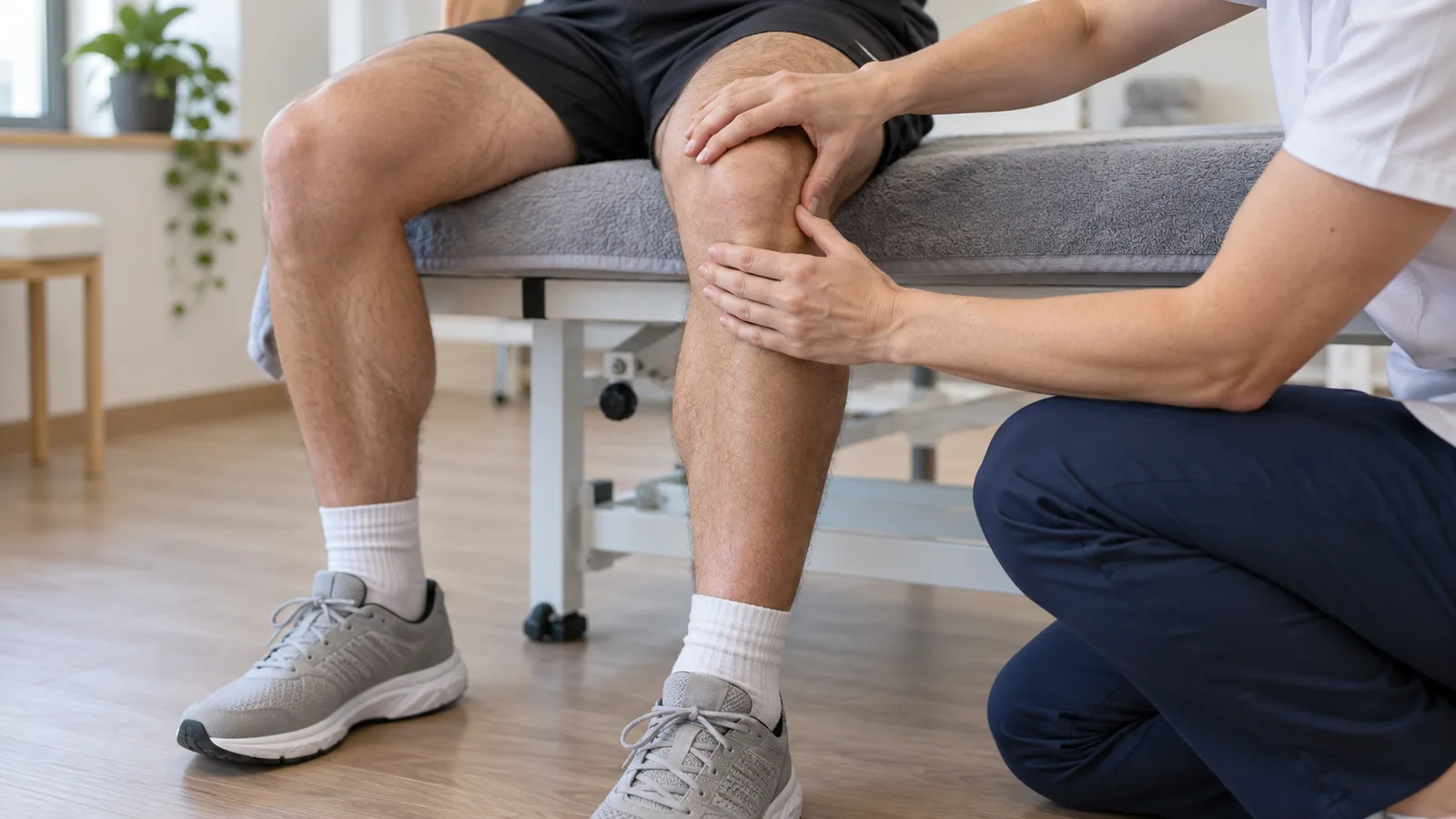
Runner's knee (patellofemoral pain): The pain sits at the front of the knee or around the kneecap, sometimes behind it. It gets worse going downstairs, squatting, running downhill and standing up after sitting for a long time with bent knees. It usually doesn't swell. What we typically find is load on the kneecap combined with weak control from the hip and thigh muscles and a sudden jump in training. If your knee swells, locks or catches when you twist, that is a different picture, which we cover in our article on meniscus tears.
Shin pain (medial tibial stress syndrome): Better known as shin splints. It is tender pain spread along several centimetres of the inner border of the shinbone, typically felt at the start of a run, may ease as you warm up and returns once you stop. Hard surfaces, sudden increases in distance and calf muscles that tire quickly are common companions.
Achilles and heel pain: Pain at the back of the heel with morning stiffness in the Achilles tendon is also common in beginners, while a stabbing pain under the heel on the first steps of the morning is usually plantar fasciitis, which we discuss in detail in our article on heel spurs and plantar fasciitis.
Stress fracture: the pain you should not wait out
The most important condition to rule out with shin pain is a stress fracture, and we want to be very clear here. In a stress fracture the pain is not spread out; it is so localised that you can point to it with one finger. It increases over the weeks, gets worse during a run instead of easing off, and does not settle with rest. Later it may hurt when walking or even at night, and pressing on one spot of the bone is sharply painful.
This is not pain to "work through" with physiotherapy. If this sounds like you, stop running and see a doctor. Imaging is usually needed, because a plain X-ray can look normal in the early stage and an MRI may be required. If a fracture is confirmed, the doctor manages the healing phase; we come in during and after that period to guide a controlled return to running.
Spread-out pain that eases as you warm up is not the same as pain in one spot that keeps building and doesn't go away with rest. For the second, your first stop is a doctor and imaging, not a physiotherapist.
Can you run with pain? The next-morning test
Not every ache means you have to stop. We use a simple distinction. Mild pain during a run that does not increase as you go and does not change the way you move usually allows you to carry on with a reduced load. Pain that keeps building, makes you limp or changes your stride means the run ends there for the day.
The key measure is the next-morning test. If the pain the morning after a run is back to where it was before the run, the load was roughly right. If it is clearly worse the next morning, or you are stiff on your first steps, the last run was more than your tissues could handle. Shorten the next session or run less often, and step back a week if needed. Masking the pain with painkillers in order to run removes this feedback completely, and we don't recommend it.
What protects you: strength work. What's overrated: shoes
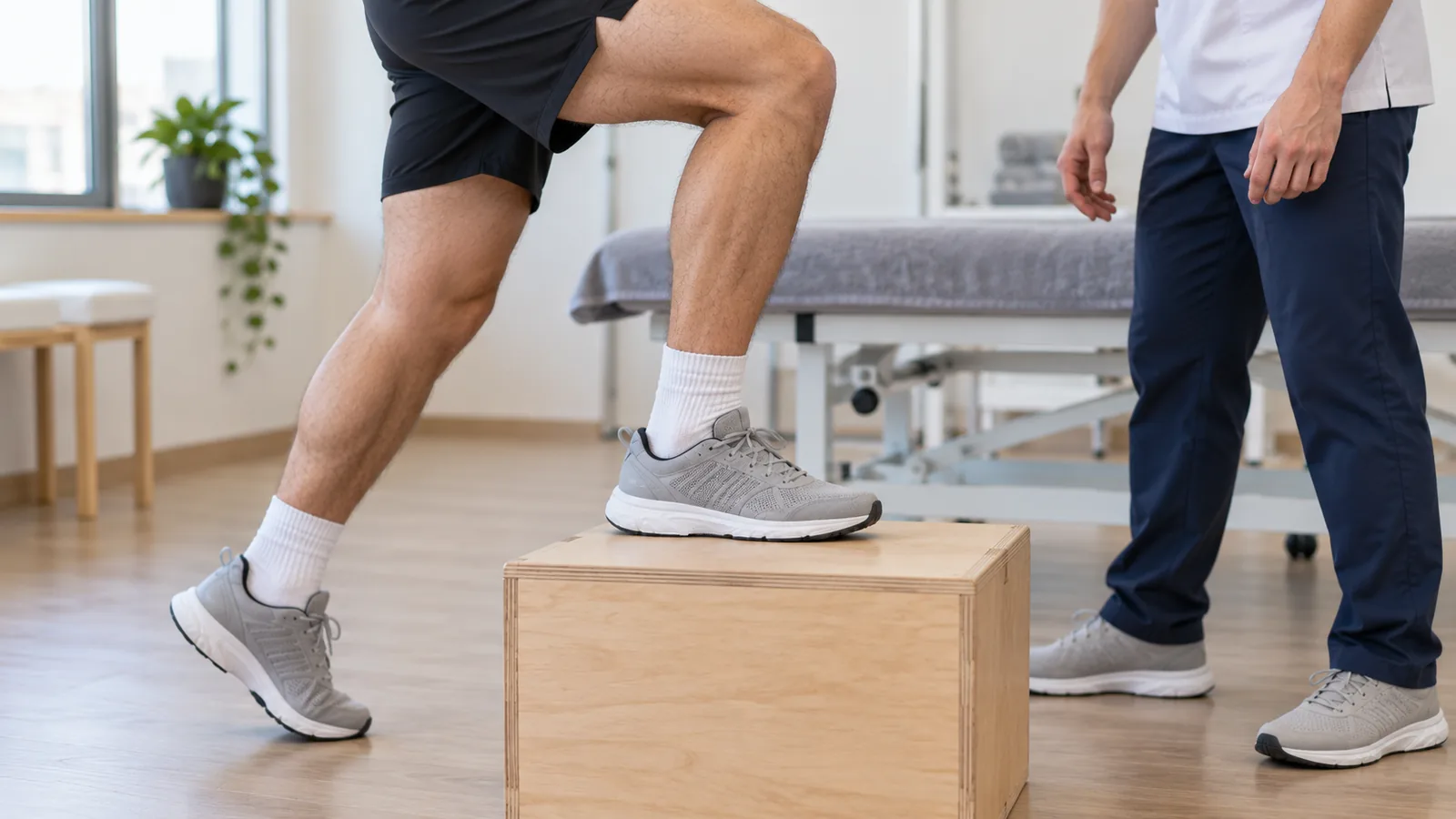
Most new runners only run. Yet every stride loads the calf, hip and thigh muscles with several times your body weight, and stronger muscles spread that load away from the knee and shin. Two strength sessions a week of twenty to thirty minutes should be a fixed part of any running plan. Example exercises:
- Single-leg calf raises: holding a wall lightly, rise slowly onto the toes of one foot and lower slowly.
- Sit-to-stand or squats: weight through the heels, knees in line with the toes, slow down and up.
- Step-ups: step onto a low step with one leg and don't let the knee drift inwards on the way down.
- Side-lying leg raises: lying on your side, lift the top leg straight up; the side hip muscles matter a lot for runner's knee.
- Bridges: on your back with knees bent, lift your hips and hold for a few seconds.
Make each exercise challenging without losing technique, and progress over time. We have gathered general prevention habits in our article on healthy habits for injury prevention.
With shoes the principle is simple: for most people, the shoe that feels comfortable on your foot is the right place to start. There is no "miracle shoe" that solves every ache. The real risk is sudden change. Switching overnight from cushioned shoes to a very thin-soled model suddenly loads the calf and Achilles much more. Introduce new shoes on short runs and alternate with your old pair for a while.
Running in Antalya: heat, sand and hills
Antalya is a wonderful city for running, with its own loads. Running at midday in summer means a risk of heat illness and early fatigue, and tired muscles protect the joints less well. From June to September, move your runs to early morning or after sunset, drink before and after, and carry water on longer runs. When humidity is high, slowing down is not weakness but sensible load management.
The flat, uninterrupted seafront paths at Konyaaltı and Lara are ideal for a beginner programme. Running on sand is less "gentle" than it looks: soft sand gives the calf and Achilles extra work with every stride, and the sloping sand at the water's edge loads one leg differently from the other. If you want to run on the beach, start with a few minutes. The hills of the Taurus foothills are great for fitness, but long descents put real load on the front of the knee; if you have runner's knee, we suggest cutting back on the downhills first.
In winter we also see many amateur runners preparing for the Runatolia marathon. The common thread is distance rushed up in the final weeks. Starting preparation early and increasing rest rather than load in the final weeks prevents most problems. And if you spend a long shift on your feet in a hotel, a kitchen or a greenhouse before heading out for a run, count that day's fatigue as part of your total load.
When should you get it checked?
Most pain in new runners settles within a few weeks of reducing load and adding strength work. But if the pain has not improved within two to three weeks despite cutting back, we recommend an assessment rather than more trial and error on your own. We identify where the pain comes from and assess your hip and calf strength, running pattern and training history. Where appropriate, we use manual therapy to support soft tissue and joint mobility and put together a return-to-running plan that suits you. To be honest about the limits: physiotherapy is not the answer to everything. A suspected stress fracture, a swollen or locking knee, or pain that keeps you awake at night needs a doctor's assessment first.
If pain at the front of your knee, along your shin or in your heel has lasted more than two weeks since you started running, you are welcome to come to our clinic for an examination. Together we will look for the cause and plan how to keep running.